
Why Parkinson’s Can Make Social Situations More Exhausting
How Parkinson’s Can Make Social Situations More Exhausting
Many people living with Parkinson’s notice that social situations can become far more tiring than they once were.
Even enjoyable conversations, family gatherings, cafés, or busy environments may quietly require much more mental and physical energy.
This can sometimes feel confusing — especially when someone still enjoys company and wants to stay socially connected.
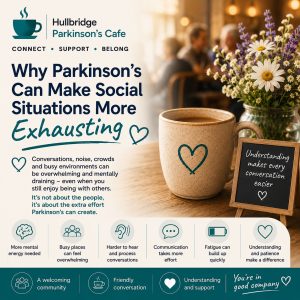
The challenge is often not the people themselves, but the extra effort Parkinson’s can place on communication, concentration, movement, and processing information.
 Parkinson’s affects more than movement
Although Parkinson’s is commonly associated with physical symptoms, it can also affect:
- mental energy
- concentration
- speech and communication
- multitasking
- processing speed
- fatigue levels
- sensory overload
When several of these challenges happen at the same time, social situations can become surprisingly draining.
According to Parkinson’s UK, fatigue and cognitive changes are common non-motor symptoms of Parkinson’s disease.
Busy environments can feel overwhelming
Many people find that noisy or crowded spaces become harder to manage with Parkinson’s.
Restaurants, cafés, supermarkets, family events, or busy public places may involve:
- multiple conversations happening at once
- background noise
- difficulty hearing clearly
- trying to follow fast-moving discussions
- processing information quickly
- managing movement and balance at the same time
The brain may need to work much harder to filter information and stay focused.
As a result, social settings that once felt easy can suddenly become mentally exhausting.
Communication itself can take more effort
Parkinson’s can also affect speech volume, facial expression, reaction time, and confidence during conversations.
We explored some of these challenges further in related articles:
When conversations require extra concentration, people may begin feeling tired much sooner than they used to.
Social exhaustion is not the same as loneliness
One important thing to understand is that someone can enjoy company while still finding social interaction exhausting.
Some people living with Parkinson’s may:
- leave events earlier
- need quiet breaks
- prefer smaller groups
- avoid noisy environments
- cancel plans when fatigued
This does not necessarily mean they no longer value friendships or social connection.
Often it simply means their energy levels and processing capacity have changed.
The emotional side can be difficult too
Social fatigue can sometimes lead to guilt, frustration, or isolation.
People may worry they are disappointing others by needing more rest or quieter environments.
Others may avoid situations entirely because they feel overwhelmed trying to keep up with conversations or noise.
This is one reason supportive and understanding communities matter so much.
Small adjustments can help
Many people find that simple changes make social situations feel more manageable.
Helpful approaches may include:
- meeting in quieter places
- keeping groups smaller
- allowing regular rest breaks
- planning social activities during better energy periods
- reducing background noise where possible
- being open about fatigue levels
Understanding from friends and family can make an enormous difference.
There is no “right” level of social activity
Parkinson’s affects everyone differently.
Some people remain highly social, while others naturally become more selective about environments and energy use.
Learning personal limits and adapting social routines is not giving up — it is often a practical way of protecting energy and wellbeing.
The value of calm and welcoming spaces
Warm, supportive environments can help reduce some of the pressure people feel in social situations.
Places where people feel understood, accepted, and able to move at their own pace often make social connection feel far more comfortable.
Sometimes simply being around people who understand can remove a huge amount of stress.
The hidden side of Parkinson’s
Social exhaustion is another reminder that many Parkinson’s symptoms remain invisible to others.
You may also find these related articles helpful:
- The Parkinson’s Iceberg
- Why Parkinson’s Can Cause Fatigue and Exhaustion
- When Parkinson’s Makes Multitasking More Difficult
Symptoms such as fatigue, concentration difficulties, speech changes, sensory overload, and anxiety may not always be visible externally, but they can still shape everyday life in major ways.
Greater awareness and compassionate understanding can help people living with Parkinson’s feel more comfortable, supported, and less alone.
⸻
Hullbridge Parkinson’s Cafe provides a calm and welcoming community space for people living with Parkinson’s, families, carers, and friends to connect and feel understood.