
Why Parkinson’s Can Affect Facial Expressions
How Parkinson’s Can Change Facial Expression and Body Language
Parkinson’s disease can affect much more than walking, balance, or tremor.
For many people, it also changes facial expression and body language in ways that may not be immediately obvious at first.
Friends or family members sometimes notice that someone with Parkinson’s appears more serious, tired, distant, or expressionless than before — even when they are feeling perfectly engaged emotionally.
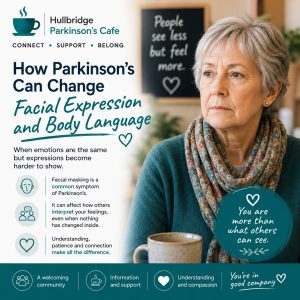
This symptom is common in Parkinson’s and is sometimes referred to as facial masking or a masked face.
 What is facial masking?
Facial masking happens because Parkinson’s can reduce automatic muscle movement in the face.
The condition affects movement speed and muscle control throughout the body, including the small muscles responsible for facial expression, blinking, smiling, and emotional reactions.
As a result, facial expressions may become less noticeable or slower to appear.
This does not mean someone is emotionally disconnected or unhappy. Often the feelings are still fully there — they are simply harder to show physically.
How facial expression changes can affect communication
Much of human communication relies on facial expression and body language.
People naturally look for visual emotional cues during conversation, such as:
- smiling
- eye contact
- raised eyebrows
- reactions to humour or emotion
- changes in expression while listening
When these movements become reduced, other people may misunderstand what someone with Parkinson’s is feeling.
Someone may wrongly appear:
- upset
- uninterested
- angry
- withdrawn
- emotionally distant
even when none of those things are true.
Parkinson’s can affect voice as well
Facial expression changes are sometimes combined with quieter speech or reduced vocal variation.
We explored this further in our related article:
When facial movement and speech both become softer, conversations can sometimes feel more difficult or emotionally flat — even when someone is fully engaged internally.
The emotional impact can be frustrating
For many people living with Parkinson’s, these misunderstandings can become emotionally exhausting.
Some people feel they are constantly being misread by others.
Others worry that family, friends, or strangers think they are unfriendly or unhappy.
Social situations can sometimes become stressful because facial expressions no longer naturally match emotions in the same way they once did.
This is one reason awareness and understanding are so important.
Facial masking does not remove personality
One of the most important things to remember is that Parkinson’s does not remove someone’s personality, emotions, humour, or warmth.
The outward physical expression may change, but the person underneath remains the same.
Sometimes family and friends simply need reassurance that reduced facial movement is part of the condition itself rather than a reflection of mood or attitude.
Small adjustments can help communication
Many people find that slowing conversations slightly and communicating more openly can help reduce misunderstandings.
Helpful approaches may include:
- maintaining calm eye contact
- speaking clearly and directly
- being patient during conversations
- focusing on words rather than facial reactions alone
- checking in rather than making assumptions
Some people with Parkinson’s also consciously exaggerate expressions slightly or use more verbal reassurance during conversations.
Supportive environments matter
Warm and understanding social environments can make a significant difference.
When people feel accepted and understood, there is often less pressure to “perform” socially or hide symptoms.
That is why supportive community spaces can be so valuable for people living with Parkinson’s, families, and carers alike.
The hidden side of Parkinson’s
Facial masking is another reminder that many Parkinson’s symptoms are invisible or misunderstood.
You may also find these related articles helpful:
- The Parkinson’s Iceberg
- Living With Parkinson’s: What People Don’t Always See
- Why Parkinson’s Can Affect Handwriting and Fine Motor Skills
Symptoms such as fatigue, speech changes, concentration difficulties, sensory symptoms, and facial masking may not always be obvious to others, but they can still have a major effect on daily life.
Greater understanding helps create more supportive communities and more compassionate conversations for people living with Parkinson’s every day.
⸻
Hullbridge Parkinson’s Cafe provides a calm and welcoming community space for people living with Parkinson’s, families, carers, and friends to connect and feel understood.