
Why Parkinson’s Can Affect Handwriting and Fine Motor Skills
How Parkinson’s Can Change Handwriting and Everyday Hand Movements
Many people living with Parkinson’s notice changes in their handwriting and ability to perform smaller, detailed movements.
Tasks such as writing, buttoning clothes, using cutlery or handling coins can gradually become more difficult over time.
These changes are very common in Parkinson’s and can affect confidence and independence in daily life.
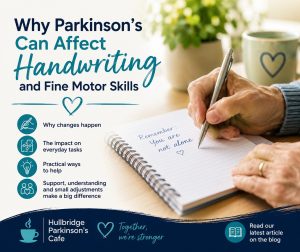 What Are Fine Motor Skills?
Fine motor skills are the small, controlled movements we use with our hands and fingers.
They are involved in everyday tasks such as:
- Writing
- Typing
- Using keys
- Fastening buttons or zips
- Holding cups or utensils
- Using a phone or remote control
Parkinson’s can make these movements slower, stiffer and less precise.
How Parkinson’s Affects Handwriting
A common symptom is handwriting becoming smaller and more cramped over time. This is known as micrographia.
Writing may also become slower or harder to control, especially when tired or when medication is wearing off.
Some people notice that their writing starts clearly but gradually becomes smaller across the page.
Why These Changes Happen
Parkinson’s affects the brain’s ability to control smooth and coordinated movement.
This can impact:
- Finger movement
- Grip strength
- Speed of movement
- Coordination
- Muscle stiffness
Even simple hand movements can begin to require more concentration and effort.
The Emotional Impact
Changes in handwriting and dexterity can feel frustrating.
Activities that once felt automatic may suddenly take longer or become tiring. Some people may avoid writing or other tasks because they feel self-conscious or embarrassed.
It is important to remember that these changes are part of Parkinson’s and not a reflection of intelligence or effort.
Practical Ways to Help
There are simple strategies that may help make daily tasks easier:
- Using larger pens with better grip
- Writing slowly and taking breaks
- Using lined paper
- Trying speech-to-text technology
- Using adaptive cutlery or kitchen tools
- Allowing extra time for tasks
Small adjustments can reduce frustration and improve confidence.
Exercise and Hand Movement
Gentle hand and finger exercises may help maintain flexibility and coordination.
Activities such as drawing, puzzles, stretching exercises or simple hand movements can help keep the hands active.
At Hullbridge Parkinson’s Cafe, Exercise for Parkinson’s (EFP) sessions encourage gentle movement and coordination in a relaxed environment.
Support and Patience
Support from carers, family and friends can make a real difference.
Patience and understanding help reduce pressure and frustration when tasks become more difficult.
Sometimes, adapting the way things are done is more important than trying to do everything exactly as before.
Helpful Links
Final Thoughts
Changes in handwriting and fine motor skills can be frustrating, but they are a recognised part of Parkinson’s.
With understanding, small adaptations and the right support, people can continue to manage everyday tasks with confidence and independence.