
Why Parkinson’s Can Make Following Group Conversations More Difficult
How Parkinson’s Can Make Following Group Conversations More Difficult
Most of us take conversations for granted.
We listen, respond, follow changes in topic, and move between speakers without giving it much thought.
For some people living with Parkinson’s, however, group conversations can become increasingly challenging.
Family gatherings, social events, support groups, restaurants, and community activities may require far more concentration and mental energy than others realise.
This is one of the hidden symptoms of Parkinson’s that often goes unnoticed by those around them.
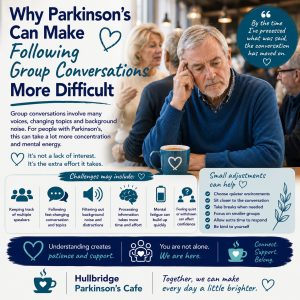 Conversations involve many different skills
Following a conversation is more complex than simply hearing words.
The brain must:
- listen to what is being said
- filter out background distractions
- identify who is speaking
- process information
- prepare a response
- keep track of changing topics
When several people are involved, these demands increase significantly.
Parkinson’s can affect information processing
Parkinson’s does not only affect movement.
It can also affect attention, concentration, processing speed, and executive functioning.
This means the brain may need more time and effort to process information and respond.
According to Parkinson’s UK, some people with Parkinson’s experience changes in attention and cognitive processing.
One-to-one conversations may feel easier
Many people find they can comfortably engage in one-to-one conversations but struggle when multiple people are talking.
In group situations, conversations may move quickly between speakers and topics.
By the time someone has processed what was said and prepared a response, the discussion may already have moved on.
Background noise can make it worse
Busy environments often create additional challenges.
Restaurants, cafés, family celebrations, and social gatherings can include competing conversations, music, and general background noise.
This can increase mental effort and make conversations feel exhausting.
You may also find this related article helpful:
It can affect confidence
Some people begin to worry about missing information, responding too slowly, or losing track of conversations.
This can sometimes lead to reduced confidence in social situations.
Others may appear quiet during discussions, not because they are uninterested, but because they are concentrating on keeping up.
Fatigue often plays a role
Following multiple conversations requires significant mental energy.
Many people find these challenges become more noticeable when they are tired or when symptoms are more pronounced.
You may also find this related article helpful:
Small adjustments can help
Many people find simple changes make social situations more comfortable.
- Choose quieter environments when possible.
- Sit closer to the people you are speaking with.
- Take breaks during longer gatherings.
- Focus on smaller groups rather than large crowds.
- Allow extra time to respond.
- Avoid feeling pressured to keep up with every conversation.
These small adjustments can often reduce stress and improve enjoyment.
Understanding matters
Because these challenges are invisible, they are often misunderstood.
Someone may appear distracted, quiet, or withdrawn when they are actually working very hard to follow the discussion.
Patience and understanding from friends, family members, and carers can make a significant difference.
The hidden side of Parkinson’s
Difficulty following group conversations is another reminder that Parkinson’s affects much more than movement alone.
You may also find these related articles helpful:
- The Parkinson’s Iceberg
- Why Parkinson’s Can Make Social Situations More Exhausting
- Why Parkinson’s Can Affect Reading and Concentration
Symptoms such as concentration difficulties, fatigue, sensory overload, communication challenges, and cognitive processing changes may not always be visible to others, but they can have a significant impact on daily life.
Greater awareness helps create understanding, patience, and support for people living with Parkinson’s.
⸻
Hullbridge Parkinson’s Cafe provides a calm and welcoming community space for people living with Parkinson’s, families, carers, and friends to connect and feel understood.