
Why Parkinson’s Can Affect Confidence
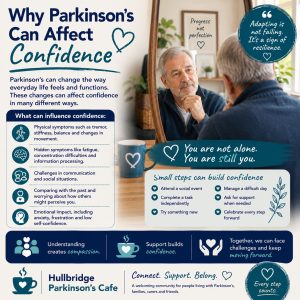
How Parkinson’s Can Affect Confidence
Confidence influences many aspects of daily life.
It affects how comfortable we feel in social situations, our willingness to try new things, our independence, and how we view ourselves.
For many people living with Parkinson’s, confidence can gradually be affected by a combination of physical, cognitive, and emotional challenges.
This is not a sign of weakness. It is often a natural response to managing a condition that can change the way everyday life feels and functions.
 Small changes can have a big impact
Parkinson’s symptoms often develop gradually.
Tasks that once felt automatic may begin to require more effort, concentration, or planning.
Over time, these changes can affect confidence in subtle ways.
Someone may become less certain about driving, walking in crowded places, attending social events, or speaking in groups.
Physical symptoms can influence self-confidence
Tremor, stiffness, balance changes, slower movement, and difficulties with facial expression can sometimes make people feel more self-conscious.
Many people worry about how others perceive them, even when those concerns are not noticed by anyone else.
You may also find these related articles helpful:
Hidden symptoms play a role too
Confidence is not only affected by physical symptoms.
Many of the hidden symptoms of Parkinson’s can have a significant impact.
Difficulties with concentration, fatigue, multitasking, decision-making, communication, or processing information may make situations feel more challenging than they once were.
When everyday activities require more effort, confidence can sometimes suffer.
Social situations may become more challenging
Some people begin to avoid situations that once felt enjoyable.
Busy environments, group conversations, unfamiliar places, or events where symptoms may become more noticeable can create anxiety.
This does not mean someone no longer wants social interaction. Often they are simply trying to manage situations that now require more energy.
Comparing yourself to the past can be difficult
Many people naturally compare their current abilities with how things used to be.
This can be one of the most challenging emotional aspects of living with Parkinson’s.
It is important to remember that adapting is not failing.
Finding new ways to do things is a sign of resilience, not weakness.
Support makes a difference
Confidence often grows when people feel understood and supported.
Family members, friends, carers, healthcare professionals, and support groups can all play an important role.
Knowing you are not facing challenges alone can make a significant difference.
Small achievements matter
Confidence is not always built through major accomplishments.
Sometimes it grows through small everyday successes.
- Attending a social event.
- Completing a task independently.
- Trying something new.
- Managing a difficult day.
- Asking for support when needed.
Every step forward matters.
The hidden side of Parkinson’s
Changes in confidence are another reminder that Parkinson’s affects much more than movement alone.
You may also find these related articles helpful:
- The Parkinson’s Iceberg
- Living With Parkinson’s: What People Don’t Always See
- Why Parkinson’s Can Make Social Situations More Exhausting
Symptoms such as fatigue, communication challenges, concentration difficulties, sensory overload, and changes in confidence may not always be visible to others, but they can have a significant impact on daily life.
With understanding, support, and self-compassion, confidence can continue to grow, even when life looks different from before.
⸻
Hullbridge Parkinson’s Cafe provides a calm and welcoming community space for people living with Parkinson’s, families, carers, and friends to connect and feel understood.