
Why Parkinson’s Can Affect Temperature Regulation
How Parkinson’s Can Affect Temperature Regulation
When people think about Parkinson’s disease, they often think about movement symptoms such as tremor, stiffness, or slower walking.
But Parkinson’s can also affect many automatic functions within the body — including how the body regulates temperature.
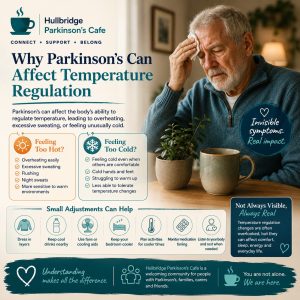
Some people living with Parkinson’s notice they become unusually sensitive to heat or cold, sweat excessively, or struggle to stay comfortable in changing temperatures.
These symptoms can feel confusing and are often rarely discussed, despite being surprisingly common.
 Parkinson’s affects the autonomic nervous system
Parkinson’s can affect the autonomic nervous system, which helps control automatic body functions such as:
- blood pressure
- digestion
- sweating
- heart rate
- temperature regulation
When these systems are affected, the body may struggle to regulate temperature in the same way it once did.
According to Parkinson’s UK, autonomic symptoms can form part of Parkinson’s disease for some people.
Some people feel excessively hot
Many people with Parkinson’s report becoming overheated more easily than before.
This can happen during:
- warm weather
- exercise
- busy environments
- stressful situations
- overnight during sleep
Some people experience excessive sweating, sometimes called hyperhidrosis.
This may affect the whole body or only certain areas such as the face, neck, or upper body.
Others feel unusually cold
Some people experience the opposite problem and feel persistently cold even when others around them feel comfortable.
Hands and feet may feel especially cold, and temperature changes can sometimes become difficult to tolerate.
This can be frustrating because the symptoms may appear inconsistent or difficult to explain to others.
Medication can sometimes play a role
Temperature regulation changes may also sometimes be linked to Parkinson’s medication cycles.
Some people notice sweating or temperature fluctuations becoming worse during “off” periods when medication effects wear down.
We explored symptom fluctuations further in our related article:
Sleep can be affected too
Temperature difficulties can sometimes disrupt sleep.
Night sweats, overheating, or struggling to stay comfortable overnight may make rest more difficult.
This can contribute further to fatigue and exhaustion during the daytime.
You may also find this related article helpful:
These symptoms are often invisible
Temperature regulation problems are another example of the hidden side of Parkinson’s.
Someone may appear physically fine while quietly dealing with overheating, sweating, chills, or discomfort throughout the day.
Because these symptoms are not always visible, they are often overlooked or misunderstood.
Small adjustments can help
Many people find practical changes help them manage temperature-related symptoms more comfortably.
Helpful approaches may include:
- dressing in layers
- keeping cool drinks nearby
- avoiding overheating where possible
- using fans or cooling aids
- keeping bedrooms cooler at night
- planning activities during cooler parts of the day
- monitoring medication timing
People experiencing severe or sudden symptoms should always discuss them with their healthcare team.
Understanding matters
Like many Parkinson’s symptoms, temperature regulation difficulties can affect comfort, confidence, energy levels, and social situations.
Simple understanding from family, friends, carers, and workplaces can make everyday life feel much less stressful.
Sometimes allowing someone to cool down, rest, or adjust their environment without judgement makes a significant difference.
The hidden side of Parkinson’s
Temperature sensitivity is another reminder that Parkinson’s affects far more than movement alone.
You may also find these related articles helpful:
- The Parkinson’s Iceberg
- Why Parkinson’s Can Make Social Situations More Exhausting
- Living With Parkinson’s: What People Don’t Always See
Symptoms such as fatigue, sweating, sensory overload, sleep disruption, concentration difficulties, and temperature sensitivity may not always be visible externally, but they can still have a major effect on daily life.
Greater awareness and compassionate understanding can help people living with Parkinson’s feel more comfortable, supported, and less alone.
⸻
Hullbridge Parkinson’s Cafe provides a calm and welcoming community space for people living with Parkinson’s, families, carers, and friends to connect and feel understood.