
Why Parkinson’s Can Reduce Automatic Movements
How Parkinson’s Can Reduce Automatic Movements
Most of us perform hundreds of movements every day without consciously thinking about them.
We blink, smile, swing our arms while walking, change facial expressions, shift position in a chair, and gesture naturally during conversation.
These actions happen automatically.
For many people living with Parkinson’s, however, some of these automatic movements gradually become reduced.
Because the changes often happen slowly, they may be overlooked or misunderstood by family, friends, and even the person experiencing them.
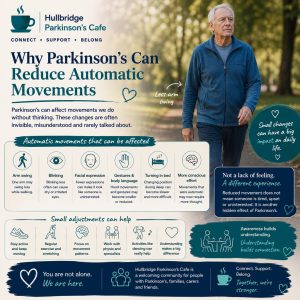 Movement is not always as automatic as it once was
Parkinson’s affects the brain’s ability to coordinate and initiate movement efficiently.
As dopamine levels change, actions that were once automatic may begin requiring more conscious effort.
This means someone may need to think about movements that previously happened naturally.
According to Parkinson’s UK, Parkinson’s can affect both voluntary and automatic movement.
Reduced arm swing while walking
One of the earliest signs sometimes noticed is a reduction in arm swing when walking.
Instead of both arms moving naturally, one arm may swing less or remain relatively still.
This often develops gradually and may be noticed by family members before the individual notices it themselves.
Blinking may become less frequent
Many people with Parkinson’s blink less often than before.
This can sometimes contribute to:
- dry eyes
- eye irritation
- watery eyes
- visual discomfort
Because blinking is usually automatic, people may not realise it has changed until symptoms appear.
Facial expression can change
Parkinson’s can also affect the small muscles involved in facial expression.
This may cause what is sometimes called facial masking.
Someone may feel happy, interested, or engaged but show fewer visible expressions than before.
We explored this further in our related article:
Gestures and body language may reduce
Many people naturally use hand movements and gestures while talking.
With Parkinson’s, these movements may become smaller or less frequent.
This can sometimes make communication more difficult because body language plays such an important role in how people connect with each other.
Turning over in bed can require more effort
Automatic movements also help us change position during sleep.
Some people with Parkinson’s notice they:
- turn over less easily
- wake feeling stiff
- need more effort to reposition themselves
- find getting comfortable more difficult
These changes can sometimes affect sleep quality and contribute to daytime fatigue.
These symptoms are often misunderstood
Because automatic movement changes happen gradually, they are often mistaken for ageing, tiredness, or simply someone’s personality changing.
In reality, they are another example of how Parkinson’s affects movement in complex ways beyond tremor alone.
Small adjustments can help
Many people find that staying active, exercising regularly, and consciously focusing on movement can help maintain mobility and confidence.
Physiotherapists and Parkinson’s specialists often encourage people to think deliberately about movement patterns that previously happened automatically.
Activities such as walking, stretching, dancing, and exercise programmes may help support movement and wellbeing.
Understanding makes a difference
Recognising these changes can help family members and carers better understand what someone with Parkinson’s is experiencing.
Reduced facial expression, less arm movement, or fewer gestures do not mean someone is uninterested, unhappy, or disengaged.
Often they are simply another hidden effect of Parkinson’s disease.
The hidden side of Parkinson’s
Reduced automatic movement is another reminder that Parkinson’s affects much more than the symptoms people usually see.
You may also find these related articles helpful:
- The Parkinson’s Iceberg
- Why Parkinson’s Can Affect Facial Expressions
- Living With Parkinson’s: What People Don’t Always See
Symptoms such as reduced arm swing, fewer facial expressions, less blinking, sleep-related movement difficulties, and changes in body language may not always attract attention, but they can still affect daily life significantly.
Greater awareness and understanding help people living with Parkinson’s feel seen, supported, and understood.
⸻
Hullbridge Parkinson’s Cafe provides a calm and welcoming community space for people living with Parkinson’s, families, carers, and friends to connect and feel understood.