
Why Parkinson’s Can Affect Your Sense of Direction and Spatial Awareness
How Parkinson’s Can Affect Your Sense of Direction and Spatial Awareness
When people think about Parkinson’s disease, they often think about tremors, stiffness, or changes in walking.
However, Parkinson’s can also affect how the brain processes information about space, distance, movement, and the environment around us.
Some people notice that judging distances becomes more difficult, navigating unfamiliar places feels more challenging, or busy environments become overwhelming.
These changes are often subtle at first but can have a significant impact on confidence and independence.
 What is spatial awareness?
Spatial awareness is our ability to understand where we are in relation to the world around us.
It helps us:
- judge distances
- navigate spaces
- avoid obstacles
- move through crowds
- use stairs safely
- park a car
- reach for objects accurately
Most of these actions happen automatically without much conscious thought.
How Parkinson’s can affect spatial awareness
Parkinson’s can affect the brain networks involved in movement, attention, visual processing, and planning.
As a result, some people find it more difficult to interpret information about the environment around them.
This can lead to uncertainty when navigating spaces or judging distances.
According to Parkinson’s UK, Parkinson’s can affect visual perception and spatial awareness for some people.
Common experiences people describe
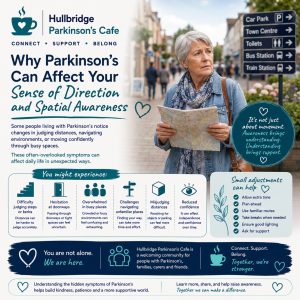
People living with Parkinson’s may experience:
- difficulty judging steps or kerbs
- hesitation when approaching doorways
- feeling uncomfortable in busy environments
- difficulty navigating unfamiliar places
- misjudging distances when reaching for objects
- reduced confidence when walking in crowds
Not everyone experiences these symptoms, but they are more common than many people realise.
Busy environments can feel overwhelming
Large shopping centres, railway stations, airports, or crowded events often contain a huge amount of visual information.
For someone with Parkinson’s, processing all of that information at once can sometimes feel exhausting.
This may contribute to stress, fatigue, or a feeling of being overwhelmed.
You may also find this related article helpful:
Confidence can be affected
Changes in spatial awareness can sometimes make people less confident about going out alone, visiting unfamiliar places, or moving around busy environments.
This is not a sign of weakness.
It often reflects the extra mental effort required to process information that was once handled automatically.
Small adjustments can help
Many people find that simple strategies make a significant difference.
- Allow extra time when travelling.
- Avoid rushing where possible.
- Use familiar routes when practical.
- Take breaks in busy environments.
- Ensure good lighting at home.
- Remove unnecessary trip hazards.
- Ask for support when needed.
Planning ahead can often reduce stress and improve confidence.
Understanding matters
Because spatial awareness difficulties are largely invisible, they are often misunderstood.
Someone hesitating at a doorway, moving cautiously on stairs, or avoiding crowded places may simply be managing a symptom that others cannot see.
Patience and understanding can make those situations far less stressful.
The hidden side of Parkinson’s
Changes in spatial awareness are another reminder that Parkinson’s affects far more than movement alone.
You may also find these related articles helpful:
- The Parkinson’s Iceberg
- Why Parkinson’s Can Affect Reading and Concentration
- Why Parkinson’s Can Affect Your Sense of Time
Symptoms such as fatigue, concentration difficulties, altered time perception, reduced automatic movements, and spatial awareness changes may not always be visible to others, but they can still shape daily life in important ways.
Greater awareness helps create understanding, confidence, and support for people living with Parkinson’s.
⸻
Hullbridge Parkinson’s Cafe provides a calm and welcoming community space for people living with Parkinson’s, families, carers, and friends to connect and feel understood.