
Why Parkinson’s Can Make You Feel Like You’re Losing Parts of Your Old Self
How Parkinson’s Can Make You Feel Like You’re Losing Parts of Your Old Self
When people think about Parkinson’s, they often focus on physical symptoms such as tremors, stiffness or changes in movement.
Yet for many people living with Parkinson’s, one of the most difficult challenges is emotional rather than physical.
It is the feeling that parts of the person they once were are slowly changing.
This can be difficult to talk about, but it is an experience that many people recognise.
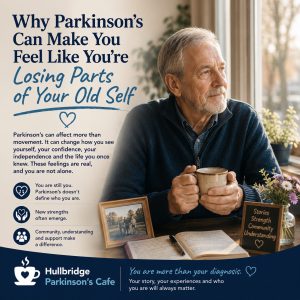 Life can start to look different
Before Parkinson’s, many everyday activities may have felt automatic.
Driving, working, socialising, travelling, hobbies and household tasks often happened without much thought.
As symptoms change over time, some of these activities may become more difficult, require more planning, or take more energy than before.
This can sometimes create a sense of loss.
It is not just about physical abilities
The emotional impact of Parkinson’s often extends beyond movement.
People may miss aspects of their former confidence, spontaneity, independence or sense of certainty.
They may find themselves comparing who they are today with who they used to be.
This is a natural response to change.
Grief is not only associated with bereavement
Many people are surprised to learn that feelings of grief can occur even when no one has died.
Grief can also occur when people experience significant changes in health, lifestyle, identity or independence.
Some people living with Parkinson’s describe grieving for activities they can no longer do as easily or for the version of themselves they remember from earlier years.
Others may not see these feelings
Because these emotions are internal, they are often invisible.
Friends and family may see someone carrying on with daily life and assume they are coping well.
In reality, they may be quietly adjusting to changes that affect how they see themselves.
This is one reason why people with Parkinson’s can sometimes feel misunderstood.
You are still you
One of the most important things to remember is that Parkinson’s does not take away a person’s value, character or identity.
Interests, memories, relationships, achievements, humour, kindness and wisdom remain part of who someone is.
While Parkinson’s may change how certain things are done, it does not erase the person behind the diagnosis.
New strengths often emerge
Many people discover strengths they never realised they possessed.
Resilience, patience, adaptability and determination often grow through life’s challenges.
Although these qualities may not replace what has changed, they can become an important part of a person’s journey.
Talking about it helps
Feelings of loss, frustration or sadness are not signs of weakness.
Talking openly with trusted friends, family members, support groups or healthcare professionals can help people process these emotions.
Many find comfort in realising they are not alone in experiencing them.
The value of community
Community spaces such as Parkinson’s support groups often provide something incredibly powerful: understanding.
Being around people who genuinely understand the challenges of Parkinson’s can help reduce feelings of isolation and remind people that their experiences are shared by others.
The hidden side of Parkinson’s
Changes in identity and self-perception are another reminder that Parkinson’s affects much more than movement alone.
You may also find these related articles helpful:
- Why Parkinson’s Can Affect Confidence
- Why Parkinson’s Can Make People Feel Misunderstood
- Living With Parkinson’s: What People Don’t Always See
It is normal to miss parts of life that have changed. But it is equally important to remember that Parkinson’s does not define a person. Behind every diagnosis is a lifetime of experiences, relationships and achievements that remain uniquely their own.
⸻
Hullbridge Parkinson’s Cafe provides a welcoming place where people living with Parkinson’s, carers, families and friends can connect, share experiences and support one another through every stage of the journey.