
Why Parkinson’s Can Make Switching Between Tasks More Difficult
How Parkinson’s Can Make Switching Between Tasks More Difficult
Most of us move between tasks throughout the day without giving it much thought.
We answer a question while making a cup of tea, stop one activity to answer the phone, or switch between conversations and responsibilities with relatively little effort.
For some people living with Parkinson’s, however, moving from one task to another can become surprisingly difficult.
This is not because they are unwilling or unable to do the task. Rather, the brain may need more time and effort to adjust its focus and move attention from one activity to the next.
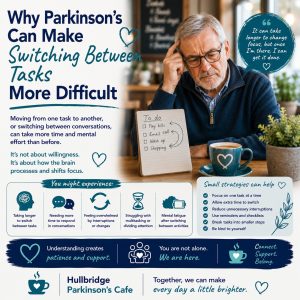 Parkinson’s affects attention as well as movement
Although Parkinson’s is often associated with physical symptoms, it can also affect attention, concentration, planning, and executive functioning.
These are the mental processes that help us organise activities, shift focus, and adapt to changing situations.
According to Parkinson’s UK, some people with Parkinson’s experience changes in cognitive function, including attention and processing speed.
Changing focus can require extra effort
Many people describe feeling comfortable once they are focused on a task, only to find interruptions frustrating or exhausting.
Examples may include:
- being interrupted while reading
- switching between conversations
- answering questions while completing another activity
- moving between different household tasks
- changing plans unexpectedly
After an interruption, it may take longer to regain concentration and return to the original task.
Multitasking often becomes more difficult
This is one reason why many people living with Parkinson’s find multitasking increasingly challenging.
Focusing on one activity at a time often feels easier and less stressful than trying to divide attention between several things at once.
You may also find this related article helpful:
Unexpected changes can feel overwhelming
Task-switching difficulties may also make sudden changes to routines more challenging.
If someone has mentally prepared for one activity, changing direction unexpectedly can require additional mental energy.
This can sometimes create frustration or fatigue, particularly on busy days.
It can affect conversations too
Switching attention is not only about practical tasks.
Conversations often move quickly between different topics, ideas, and responses.
Some people find it takes longer to process these changes and formulate responses, especially in noisy or busy environments.
Small strategies can help
Many people find that simple adjustments make everyday life easier.
- Focus on one task at a time.
- Reduce unnecessary interruptions where possible.
- Allow extra time to change activities.
- Use written reminders when returning to tasks.
- Break larger activities into manageable steps.
- Avoid feeling pressured to rush.
These approaches can help reduce stress and improve confidence.
Understanding matters
Because task-switching difficulties are largely invisible, others may not realise how much mental effort is involved.
Someone may appear distracted or slow to respond when in reality their brain is simply taking longer to adjust focus.
Patience and understanding can make a significant difference.
The hidden side of Parkinson’s
Difficulty switching between tasks is another reminder that Parkinson’s affects much more than movement alone.
You may also find these related articles helpful:
- The Parkinson’s Iceberg
- Why Parkinson’s Can Affect Reading and Concentration
- Why Parkinson’s Can Make It Harder to Start Tasks
Symptoms such as concentration difficulties, fatigue, sensory overload, task initiation challenges, and attention-switching problems may not always be visible to others, but they can significantly affect daily life.
Greater awareness helps create patience, understanding, and support for people living with Parkinson’s.
⸻
Hullbridge Parkinson’s Cafe provides a calm and welcoming community space for people living with Parkinson’s, families, carers, and friends to connect and feel understood.