
When Everything Gets a Little Smaller: Parkinson’s and the Movements We Don’t Notice

Watch two people having an animated conversation.

They don’t only talk with their voices.

Hands move.

Arms gesture.

Shoulders shift.

Faces react.

Someone leans forward when they’re interested.

They turn towards the person speaking.

They nod.

They point.

They shrug.

Most of this happens without anybody consciously deciding to do it.

We simply move.

But Parkinson’s can change something quite subtle about movement.

It doesn’t necessarily stop a movement completely.

Sometimes it makes the movement smaller.

Read more “When Everything Gets a Little Smaller: Parkinson’s and the Movements We Don’t Notice”
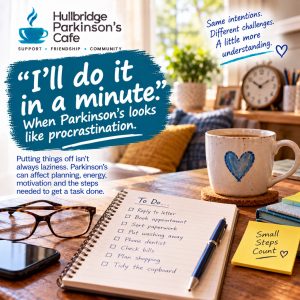
“I’ll Do It in a Minute” — When Parkinson’s Looks Like Procrastination

The letter has been sitting on the table for three days.

You know it needs answering.

You haven’t forgotten about it.

In fact, you’ve thought about it at least fifteen times.

Each time, the same thought:

Parkinson’s and Putting Things Off: It Isn’t Always Procrastination - PCUK“I’ll do it in a minute.”

Then something happens.

Perhaps you become tired.

Perhaps another task takes longer than expected.

Perhaps you can’t quite decide what to write.

Perhaps the right moment simply never seems to arrive.

Tomorrow comes.

The letter is still there.

From the outside, this can look very familiar.

Procrastination.

We all do it.

But for somebody living with Parkinson’s, there can sometimes be much more happening behind that apparently simple delay.

Read more ““I’ll Do It in a Minute” — When Parkinson’s Looks Like Procrastination”

The Hardest Part Can Be Starting: Parkinson’s and That First Step

You know you need to get up.

You want to get up.

You are perfectly capable of getting up.

But for some reason, you are still sitting there.

Or perhaps you’re standing at the bottom of the stairs.

You know where you’re going.

Yet beginning feels disproportionately difficult.

Maybe the washing needs putting away, you need to get dressed, make lunch, go outside or start getting ready for an appointment.

Once you’re doing it, you may be fine.

It is that first movement — that transition from not doing to doing — that can sometimes feel like the biggest hurdle.

For people living with Parkinson’s, this can be a very real part of everyday life.

And from the outside, it can be easily misunderstood.

Read more “The Hardest Part Can Be Starting: Parkinson’s and That First Step”

“Don’t Watch Me!” — Why Parkinson’s Can Make Things Harder When Someone Is Waiting

You know how to do it.

You have done it hundreds — perhaps thousands — of times before.

Then somebody stands there watching you.

And suddenly it becomes much harder.

You are trying to put your PIN into a card machine while people wait behind you.

Your fingers don’t seem to cooperate.

You are fastening a button while your partner stands ready to help.

The button suddenly feels impossible.

You are signing your name while somebody watches from the other side of the counter.

Your handwriting becomes worse.

You are trying to get out of a chair while everybody else is already standing.

Now your body seems even less willing to move.

For some people living with Parkinson’s, there can be an enormous difference between doing something in their own time and doing exactly the same thing while somebody is watching, waiting or urging them to hurry.

Read more ““Don’t Watch Me!” — Why Parkinson’s Can Make Things Harder When Someone Is Waiting”

Why Interruptions Can Be So Frustrating With Parkinson’s

“Where Was I?”

You’re halfway through making a cup of tea when somebody asks you a question.

You answer them.

Then you look back at the kitchen worktop.

And for a moment you think:

“What was I doing?”

Or perhaps you’re telling somebody a story.

They interrupt with a quick comment.

You respond.

Then comes the dreaded:

“I’ve completely forgotten what I was going to say.”

Everybody experiences this occasionally.

But for some people living with Parkinson’s, interruptions can be particularly disruptive.

It isn’t necessarily that the person has forgotten how to make tea, finish getting dressed or complete whatever task they were doing.

The difficulty can be getting back to the point where they were interrupted.

Read more “Why Interruptions Can Be So Frustrating With Parkinson’s”