
When Everything Gets a Little Smaller: Parkinson’s and the Movements We Don’t Notice
Watch two people having an animated conversation.
They don’t only talk with their voices.
Hands move.
Arms gesture.
Shoulders shift.
Faces react.
Someone leans forward when they’re interested.
They turn towards the person speaking.
They nod.
They point.
They shrug.
Most of this happens without anybody consciously deciding to do it.
We simply move.
But Parkinson’s can change something quite subtle about movement.
It doesn’t necessarily stop a movement completely.
Sometimes it makes the movement smaller.
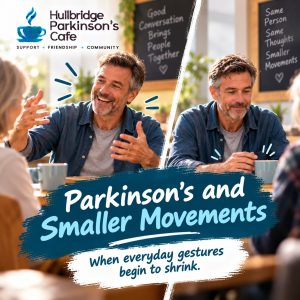 Parkinson’s Isn’t Only About Moving Slowly
One of the main movement symptoms associated with Parkinson’s is bradykinesia.
The word is often described simply as slowness of movement.
But bradykinesia can involve more than speed.
Movement may also become reduced in amplitude — in other words, smaller.
A step may become shorter.
An arm may swing less while walking.
Handwriting may become smaller.
A gesture that was once broad and obvious may become much more restrained.
Facial movement can also become reduced for some people.
None of these changes necessarily happen at the same time, and Parkinson’s affects everyone differently.
But together they reveal something interesting about the condition.
Sometimes the movement is still there.
There is simply less of it.
The Missing Arm Swing
Arm swing is a good example because most of us rarely think about it.
When we walk, our arms naturally tend to swing alongside our body.
We don’t normally leave the house thinking:
“Right. Left leg forward, right arm forward, now swap.”
It happens automatically.
Reduced arm swing can occur in Parkinson’s and may sometimes be more noticeable on one side.
The person themselves may not initially notice.
Someone walking behind them might.
Or a family member may eventually say:
“Your arm doesn’t seem to move when you walk anymore.”
Once somebody points it out, it can suddenly seem obvious.
Before that, it may have been happening gradually for some time.
Our Hands Talk Too
Now think about conversation.
Some people barely move their hands when they speak.
Others could probably communicate half a story without saying a word.
Gestures add emphasis and emotion.
They help illustrate size, direction and movement.
They can show excitement, frustration, disbelief or humour.
If those gestures become smaller, the person may appear less animated even though their thoughts and feelings haven’t changed.
That matters because other people unconsciously read body language constantly.
A quieter body can easily be mistaken for a quieter personality.
“You Don’t Seem Very Interested”
Imagine somebody is listening to a story.
They are genuinely interested.
But they aren’t nodding as noticeably.
Their facial expression is reduced.
They aren’t moving their hands.
Their posture hasn’t changed much.
To the storyteller, something feels different.
Perhaps they think:
“I’m boring them.”
“They’re not listening.”
“They don’t seem pleased to see me.”
But the conclusion may be completely wrong.
The person’s internal response can be exactly the same even if some of the external signals have become less obvious.
Less visible movement does not necessarily mean less interest, less emotion or less engagement.
The Volume Knob Has Been Turned Down
One way to imagine this is as a volume control.
The movement hasn’t necessarily been switched off.
The volume has been turned down.
A big gesture becomes a small gesture.
A long stride becomes a shorter one.
A clear nod becomes a slight movement.
A large handwritten word becomes smaller.
The intention may remain.
But the physical expression of that intention has changed.
Handwriting Is Perhaps the Most Obvious Example
Some people with Parkinson’s experience micrographia, where handwriting becomes unusually small or progressively smaller as they write.
Someone may begin a sentence at a relatively normal size and find that the letters gradually shrink across the page.
Again, this demonstrates that Parkinson’s isn’t simply making movement slower.
It can affect the scale of the movement being produced.
The person may feel as though they’re writing normally.
Then they look at the page.
The writing tells a different story.
Your Internal Idea of “Big Enough” May Change
This is one of the particularly interesting aspects of Parkinson’s movement.
For some people, a movement that feels normal to them may appear smaller to somebody watching.
They aren’t necessarily deliberately taking tiny steps.
They may not feel that their gesture is particularly small.
The movement their brain and body produce as “normal” can be reduced.
This helps explain why certain therapeutic approaches may encourage people to consciously practise larger movements.
What initially feels exaggerated may actually appear much closer to an ordinary-sized movement to everybody else.
“Bigger” Can Feel Surprisingly Big
Imagine being asked to take a bigger step.
You deliberately exaggerate it.
To you, it feels enormous.
To the person watching, it may simply look like a normal stride.
That difference between how movement feels and how it appears can be surprising.
This is also why simply telling somebody:
“Take bigger steps.”
isn’t necessarily enough.
Appropriate assessment and guidance from a physiotherapist or other Parkinson’s specialist may help identify strategies suitable for the individual.
It Can Affect Everyday Reach
Smaller movement isn’t confined to walking or handwriting.
Think about reaching.
Putting an arm fully into a coat sleeve.
Reaching across a table.
Taking something from a cupboard.
Turning over in bed.
Moving around while getting dressed.
If the movement becomes smaller, an everyday task can require another attempt.
The hand doesn’t quite reach the object.
The sleeve doesn’t quite go on.
The body doesn’t quite turn far enough.
These are tiny differences.
Repeated dozens of times throughout the day, they can become tiring and frustrating.
Walking Can Gradually Become More Compact
Shorter steps are another example.
Someone may still be walking independently.
But their stride becomes shorter.
They may take more steps to cover the same distance.
Turning may require several smaller steps rather than one smooth movement.
As movement becomes more compact, getting around can take longer and require more concentration.
Again, the important point is that the ability hasn’t necessarily disappeared.
The way the movement is being produced has changed.
Other People May Start Filling in the Missing Signals
Humans dislike incomplete information.
If someone’s body language becomes less expressive, we tend to interpret what we see.
Unfortunately, we don’t always interpret it correctly.
Reduced movement may be read as:
- lack of enthusiasm;
- boredom;
- unfriendliness;
- low confidence;
- disagreement;
- tiredness;
- or simply “not being themselves”.
Sometimes one of those interpretations will be right.
Sometimes none of them will.
This is why knowing somebody has Parkinson’s can help us avoid relying entirely on body language.
If you’re unsure how somebody feels, there is a wonderfully sophisticated communication technique available:
Ask them.
Don’t Demand a Performance
There is an important balance here.
Understanding reduced movement doesn’t mean someone with Parkinson’s should be expected to compensate constantly for everyone else’s benefit.
They shouldn’t have to deliberately smile more so other people feel comfortable.
They shouldn’t have to exaggerate enthusiasm to prove they’re interested.
They shouldn’t have to consciously animate every conversation.
Awareness works both ways.
Sometimes the people around them need to learn that the signals they once relied upon may have changed.
It Can Be Particularly Relevant at Work
Body language influences professional judgements more than we sometimes admit.
We notice who appears enthusiastic in a meeting.
Who leans forward.
Who gestures.
Who looks energetic.
Who appears confident during a presentation.
Imagine an employee with Parkinson’s whose movements or facial expression have become reduced.
Their knowledge hasn’t disappeared.
Their commitment hasn’t necessarily changed.
Their interest in the discussion may be exactly the same.
But if colleagues unconsciously interpret reduced physical expression as disengagement, that employee can be judged on something completely unrelated to the quality of their contribution.
Inclusive workplaces need to recognise that communication doesn’t look identical in everybody.
Video Calls Can Magnify the Problem
Modern working practices add another interesting dimension.
On a video call, much of the body disappears.
We may only see someone’s face and shoulders.
Subtle changes in facial movement or gesture can therefore become more significant because there are fewer other communication cues available.
A person who appears quiet or expressionless on screen may still be following every word.
Once again, contribution should be judged by what somebody actually contributes — not simply by how animated they appear while listening.
Family Members Notice Changes Others Miss
Because these changes can happen gradually, the people closest to someone may notice them first.
Perhaps a partner sees that one arm isn’t swinging.
A daughter notices Dad’s handwriting has become tiny.
A friend realises someone’s gestures aren’t as expansive as they used to be.
These observations can sometimes be useful information to share with the person’s healthcare team, particularly if the change is new or affecting everyday activities.
But there is a difference between noticing and constantly monitoring.
Nobody wants every movement analysed over breakfast.
Parkinson’s already demands enough attention.
Movement Can Sometimes Benefit From Conscious Attention
One of the strange things about Parkinson’s is that movements which were once automatic may sometimes benefit from becoming more deliberate.
Think about taking a larger step.
Making a more purposeful turn.
Reaching fully.
Using a cue or rhythm when walking.
Strategies vary, and what helps one person may not help another.
Physiotherapists with experience in Parkinson’s can assess movement and recommend appropriate exercises or strategies.
The aim isn’t to tell someone simply to “try harder”.
It is to find approaches that work with the particular movement difficulty they are experiencing.
Small Movement Does Not Mean a Smaller Life
There is also a broader point worth making.
Parkinson’s may make a person’s movements smaller.
It doesn’t make the person smaller.
Their opinions haven’t shrunk.
Their humour hasn’t shrunk.
Their experience hasn’t shrunk.
Their relationships haven’t suddenly become less important.
Their contribution to a conversation isn’t measured by how much they wave their hands while making it.
We need to be careful not to allow reduced physical expression to reduce the space we give somebody socially.
Look Beyond the Movement
Perhaps that is the most useful message.
We communicate with our bodies constantly.
Parkinson’s can change some of those signals.
When it does, the people around us may need to adjust how they read them.
Don’t assume somebody isn’t interested because they aren’t nodding as much.
Don’t assume they’re unhappy because their face isn’t showing what you expect.
Don’t assume they’re disengaged because their gestures are smaller.
Don’t assume that because a movement is small, the thought behind it is small too.
Listen to the words.
Give the person time.
And when you’re unsure, ask rather than interpret.
Because Parkinson’s can turn down the volume on movement.
It doesn’t turn down the person.
Hullbridge Parkinson’s Cafe is a friendly, informal community for people living with Parkinson’s, their partners, families and carers.
We meet at Hullbridge Free Church, 47–48 Lower Road, Hullbridge, Essex SS5 6DF, on the first and third Tuesday of each month from 11:00am–1:00pm.
No booking is required and new faces are always welcome.
Find out more at https://parkinsonscafe.co.uk/
If you notice new or significant changes in movement, walking or everyday function, discuss them with an appropriate healthcare professional, such as your Parkinson’s nurse, physiotherapist, GP or specialist. Symptoms and appropriate strategies vary from person to person.