
Why Parkinson’s Can Make It Harder to Start Tasks
How Parkinson’s Can Make It Harder to Start Tasks
Have you ever wanted to do something but found yourself struggling to get started?
For some people living with Parkinson’s, this can happen far more often than others realise.
A task may be fully understood, important, and something they genuinely want to do, yet taking that first step can feel unexpectedly difficult.
This symptom is often misunderstood because it can look like procrastination, lack of motivation, or forgetfulness when something very different is happening.
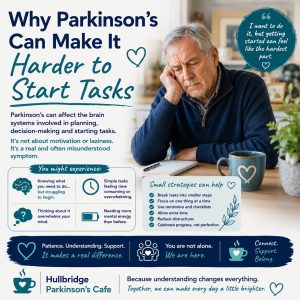 Parkinson’s affects more than movement
Parkinson’s is commonly associated with physical symptoms such as tremor, stiffness, and slower movement.
However, the condition can also affect the brain systems involved in planning, decision-making, attention, and initiating actions.
This means that starting a task may require more mental effort than it once did.
According to Parkinson’s UK, Parkinson’s can affect cognitive functions including planning and executive functioning.
Wanting to do something and starting it are not the same thing
One of the most frustrating aspects of this symptom is that the desire to complete a task is often still there.
Someone may want to:
- reply to a message
- make a phone call
- start household chores
- complete paperwork
- prepare a meal
- attend a social activity
Yet getting started can feel like a much bigger hurdle than it used to be.
Small tasks can feel unexpectedly overwhelming
Sometimes the challenge is not the task itself but the number of steps involved.
What once felt simple may now require more planning and mental organisation.
The brain may be working harder behind the scenes to process information and organise actions.
Others may misunderstand
Because this symptom is largely invisible, it is often mistaken for laziness, disinterest, stubbornness, or a lack of effort.
In reality, the person may be trying extremely hard to begin the task.
This misunderstanding can sometimes lead to frustration for everyone involved.
Stress can make it harder
Feeling pressured, rushed, or criticised can sometimes make task initiation even more difficult.
Many people find that calm environments, patience, and breaking activities into smaller steps help reduce the mental barrier to getting started.
You may also find these related articles helpful:
- Why Parkinson’s Can Affect Your Sense of Time
- Why Parkinson’s Can Make Everyday Decisions More Difficult
Small strategies can help
Many people develop practical approaches that make everyday activities easier.
- Break large tasks into smaller steps.
- Focus on one activity at a time.
- Use written reminders and checklists.
- Allow extra time where possible.
- Reduce distractions.
- Celebrate progress rather than perfection.
Even small successes can build confidence.
Support and understanding matter
Sometimes the most helpful thing family members, friends, and carers can offer is patience.
Gentle encouragement often works better than pressure.
Recognising that Parkinson’s may be creating an invisible barrier can help everyone approach the situation with greater understanding.
The hidden side of Parkinson’s
Difficulty starting tasks is another reminder that Parkinson’s affects far more than movement alone.
You may also find these related articles helpful:
- The Parkinson’s Iceberg
- Why Parkinson’s Can Affect Motivation and Initiative
- Living With Parkinson’s: What People Don’t Always See
Symptoms such as task initiation difficulties, fatigue, concentration challenges, sensory overload, and communication changes may not always be visible to others, but they can have a significant impact on daily life.
Greater awareness helps create patience, understanding, and support for people living with Parkinson’s.
⸻
Hullbridge Parkinson’s Cafe provides a calm and welcoming community space for people living with Parkinson’s, families, carers, and friends to connect and feel understood.