
Why Parkinson’s Can Make Everyday Decisions More Difficult
How Parkinson’s Can Make Everyday Decisions More Difficult
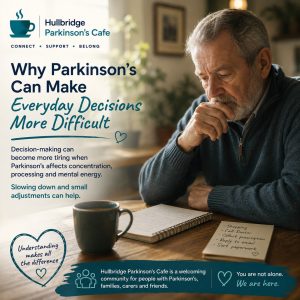
Many people living with Parkinson’s notice that making decisions can gradually become more mentally tiring than it once was.
Simple everyday choices — what to wear, what to cook, replying to messages, organising appointments, or deciding what to do first — may suddenly require much more thought and energy.
These changes are often subtle at first, but over time they can quietly affect confidence, routines, and mental wellbeing.
Because decision-making difficulties are mostly invisible, they are sometimes misunderstood by others as indecisiveness, distraction, or lack of motivation.
 Parkinson’s affects more than movement
Although Parkinson’s is widely known for physical symptoms such as tremor, stiffness, and slower movement, it can also affect:
- mental processing
- attention
- concentration
- multitasking
- planning
- mental energy
- confidence in decision-making
According to Parkinson’s UK, cognitive changes can form part of Parkinson’s disease for some people.
Too many choices can feel overwhelming
Many people find that large amounts of information or too many options become mentally draining.
Things such as:
- busy shopping environments
- paperwork and forms
- technology menus
- planning journeys
- making appointments
- following multiple instructions
can sometimes feel unexpectedly overwhelming.
The brain may need more time to process information and organise thoughts than it once did.
Fatigue often makes decision-making harder
Mental fatigue can play a major role in decision-making difficulties.
We explored this further in our related article:
When someone is already using extra mental energy for concentration, movement, communication, and managing symptoms, even small decisions can begin to feel exhausting.
Stress and pressure can increase the difficulty
Many people notice that making decisions becomes harder when they feel rushed, tired, anxious, or under pressure.
Fast-paced environments or situations where quick responses are expected may increase stress and mental overload.
This can sometimes lead to:
- second-guessing decisions
- difficulty prioritising tasks
- avoiding decisions altogether
- feeling mentally “stuck”
- becoming overwhelmed more quickly
This is not laziness or lack of intelligence
One of the most important things to understand is that these changes are not a reflection of someone’s intelligence, personality, or effort.
Often the person themselves is already frustrated by how much mental effort everyday tasks now require.
What once felt automatic may now involve far more concentration behind the scenes.
Small adjustments can help
Many people find practical adaptations help reduce mental overload and make decisions feel more manageable.
Helpful approaches may include:
- breaking tasks into smaller steps
- reducing distractions
- allowing extra time
- using lists and reminders
- simplifying routines where possible
- avoiding rushing
- making important decisions during higher-energy periods
Supportive environments and patient communication can also make a huge difference.
Confidence can be affected too
Decision-making difficulties sometimes affect confidence and independence.
People may begin doubting themselves or worry about making mistakes.
This can lead to frustration, embarrassment, or withdrawing from situations that once felt manageable.
Understanding and reassurance from family, carers, and friends can help reduce some of that pressure.
There is no “correct” pace
Parkinson’s affects everyone differently.
Some days may feel mentally clearer and more manageable than others.
Learning to slow things down, reduce unnecessary pressure, and work with changing energy levels can help everyday life feel more manageable.
Taking longer to process information does not mean someone is incapable.
The hidden side of Parkinson’s
Decision-making difficulties are another reminder that Parkinson’s affects far more than movement alone.
You may also find these related articles helpful:
- The Parkinson’s Iceberg
- When Parkinson’s Makes Multitasking More Difficult
- Why Parkinson’s Can Affect Reading and Concentration
Symptoms such as fatigue, concentration difficulties, communication changes, anxiety, and mental overload may not always be visible externally, but they can still shape daily life in significant ways.
Greater awareness and compassionate understanding can help people living with Parkinson’s feel more supported, confident, and less alone.
⸻
Hullbridge Parkinson’s Cafe provides a calm and welcoming community space for people living with Parkinson’s, families, carers, and friends to connect and feel understood.