
Why Parkinson’s Can Affect Motivation and Initiative
How Parkinson’s Can Affect Motivation and Initiative
One of the lesser-understood symptoms of Parkinson’s disease is the effect it can have on motivation and initiative.
Some people notice that starting tasks, making decisions, or finding the mental energy to begin activities becomes harder over time.
This can feel confusing and frustrating — especially when someone still wants to do things emotionally but struggles to “get going” mentally or physically.
Because these changes are mostly invisible, they are sometimes misunderstood by others as laziness, disinterest, or simply “not trying hard enough.”
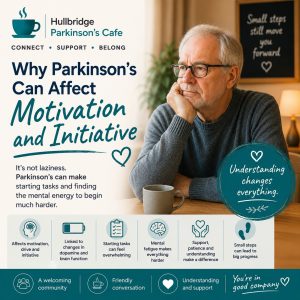 Parkinson’s affects more than movement
Parkinson’s disease affects areas of the brain linked not only to movement, but also motivation, planning, attention, and emotional processing.
Dopamine plays an important role in reward, drive, and initiating action. As dopamine pathways become affected in Parkinson’s, some people experience changes in:
- motivation
- initiative
- decision-making
- mental energy
- interest in activities
According to Parkinson’s UK, apathy and reduced motivation can be part of Parkinson’s for some people.
Wanting to do something and starting it are not always the same
One of the hardest parts to explain is that someone with Parkinson’s may genuinely want to do something while still finding it difficult to begin.
This is not simply a matter of willpower.
Tasks that once felt automatic may suddenly require far more mental effort and planning.
Even relatively simple activities such as:
- replying to messages
- making phone calls
- getting dressed
- starting household tasks
- organising appointments
- leaving the house
can sometimes feel unexpectedly overwhelming.
Fatigue and motivation are often connected
Motivation difficulties are frequently linked with Parkinson’s fatigue and mental exhaustion.
We explored this further in our related article:
When the brain and body are already using extra energy for movement, concentration, and daily functioning, starting new tasks can become mentally draining.
The emotional impact can be misunderstood
Reduced initiative can sometimes affect relationships, family dynamics, or confidence.
Partners, friends, or relatives may not always realise these changes are part of Parkinson’s itself.
This can sometimes lead to frustration on both sides.
People living with Parkinson’s may feel guilty, embarrassed, or angry with themselves for struggling to complete things they once managed easily.
Small steps often work better than pressure
Many people find that breaking tasks into smaller steps helps reduce feelings of overwhelm.
Helpful approaches may include:
- focusing on one task at a time
- creating simple routines
- using reminders and prompts
- allowing extra time
- reducing distractions
- celebrating small achievements
- avoiding self-criticism
Supportive encouragement is often far more helpful than pressure or frustration.
Understanding matters
One of the most valuable things family, friends, carers, and communities can offer is understanding.
Recognising that Parkinson’s can affect motivation and initiative helps reduce judgement and misunderstandings.
Often the person themselves is already deeply aware of the struggle happening internally.
There is no “correct” pace
Parkinson’s affects everyone differently.
Some days may feel productive and manageable, while others feel slower and mentally heavier.
Learning to adapt routines, reduce pressure, and work with changing energy levels can help make daily life feel more manageable.
Taking things slowly does not mean someone is failing.
The hidden side of Parkinson’s
Changes to motivation and initiative are another reminder that many Parkinson’s symptoms remain largely invisible.
You may also find these related articles helpful:
- The Parkinson’s Iceberg
- When Parkinson’s Makes Multitasking More Difficult
- Living With Parkinson’s: What People Don’t Always See
Symptoms such as fatigue, concentration difficulties, anxiety, communication changes, and reduced motivation may not always be visible to others, but they can still have a major impact on daily life.
Greater awareness and compassionate understanding can help people living with Parkinson’s feel less isolated and more supported.
⸻
Hullbridge Parkinson’s Cafe provides a calm and welcoming community space for people living with Parkinson’s, families, carers, and friends to connect and feel understood.