
Why Parkinson’s Can Make You Feel More Tired Than You Expect
Most of us know what it feels like to be tired after a busy day.
But many people living with Parkinson’s describe a very different kind of tiredness.
It can appear without warning, even after a good night’s sleep or on days when you’ve done very little physically.
This isn’t laziness, and it isn’t something you can simply “push through”. Parkinson’s-related fatigue is a recognised symptom of the condition and can have a significant impact on everyday life.
Understanding why it happens is the first step towards managing it.
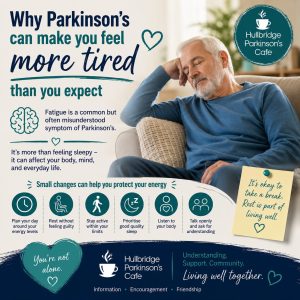 Fatigue Is More Than Feeling Sleepy
Fatigue and sleepiness are not the same thing.
You might sleep well at night but still wake up feeling that your energy is limited.
Many people describe fatigue as feeling physically and mentally drained, making even simple tasks seem much harder than they should.
It can affect concentration, motivation and confidence just as much as physical movement.
Why Does Parkinson’s Cause Fatigue?
There isn’t one single cause.
Fatigue may be linked to the changes Parkinson’s causes within the brain, the extra effort required to move, medication, sleep disturbances or simply the body’s increased workload throughout the day.
Everyone experiences it differently, which is why recognising your own patterns can be so helpful.
Listen to Your Energy, Not the Clock
Many people find they have certain times of the day when they feel at their best.
If possible, try to plan important activities during those periods.
You may discover that shopping is easier in the morning, while the afternoon is better suited to rest or quieter activities.
Working with your body’s natural rhythm is often more effective than fighting against it.
Rest Without Feeling Guilty
Rest is not giving up.
It’s part of managing Parkinson’s well.
Taking a short break before becoming exhausted can often leave you with more energy overall than trying to keep going until you’re completely worn out.
Listening to your body is a strength, not a weakness.
Keep Moving—Within Your Limits
It may seem surprising, but gentle physical activity can actually improve energy levels.
Walking, stretching, swimming or Parkinson’s-specific exercise classes can all help maintain strength and reduce fatigue over time.
The key is finding an activity you enjoy and doing it at a pace that feels comfortable for you.
Accept That Every Day Is Different
One of the realities of Parkinson’s is that today’s energy levels may be very different from tomorrow’s.
Some days you’ll achieve everything you planned.
Other days, simply getting out for a walk may be enough.
Both days are equally valid.
Success isn’t measured by how much you do. Sometimes it’s measured by recognising what your body needs.
You Don’t Have to Explain Yourself
Fatigue is often invisible.
Friends and family may not realise how exhausting Parkinson’s can be.
Talking openly about your energy levels can help others understand why you occasionally need to slow down, change plans or take a break.
The people who care about you will usually be far more understanding than you expect.
Living Well Includes Rest
Living well with Parkinson’s doesn’t mean being active every minute of every day.
It means finding the right balance between activity, rest, movement and enjoyment.
By understanding your body, planning ahead and giving yourself permission to recharge, you can make better use of the energy you have.
At Hullbridge Parkinson’s Cafe, we often remind one another that Parkinson’s isn’t a race.
Take life at your own pace.
Because sometimes the strongest thing you can do is simply recognise when it’s time to rest.
How do you manage fatigue?
Whether it’s planning your day differently, taking regular breaks or finding an exercise routine that works for you, your experience may help someone else living with Parkinson’s.