
Why Getting Ready Can Take So Much Longer With Parkinson’s
We recently asked our community about something many people living with Parkinson’s will recognise: everyday life doesn’t always run to the same timetable it once did.
One response summed it up perfectly:
“A quick 10 minute shower and change is now over an hour.”
It’s a simple comment, but it says a great deal.
Because to somebody watching from the outside, having a shower and getting dressed might appear to be one task.
It isn’t.
It’s dozens of smaller tasks performed one after another.
And when Parkinson’s affects movement, dexterity, balance, energy or the ability to initiate an action, all those little tasks can begin to take longer.
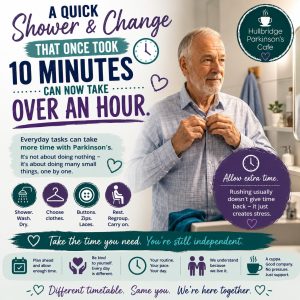 A “Quick Shower” Isn’t Really One Activity
Think about everything involved in getting showered and dressed.
You need to get out of bed or a chair.
Walk to the bathroom.
Undress.
Step into or access the shower safely.
Adjust the water.
Wash your hair and body.
Reach for toiletries.
Turn around.
Dry yourself.
Get dressed.
Fasten buttons, zips or other clothing.
Put on socks.
Put on shoes.
Perhaps shave, style your hair or complete another part of your usual routine.
For many people, the brain coordinates these actions so automatically that we barely notice them.
But when several of those individual movements become slower or require more concentration, the total time can increase dramatically.
Slowness of Movement Can Affect Everyday Routines
One of the main movement symptoms associated with Parkinson’s is bradykinesia, meaning slowness of movement.
This doesn’t simply mean somebody walks more slowly.
It can affect many everyday actions.
Reaching for something.
Moving an arm into a sleeve.
Turning.
Standing up.
Starting a movement.
Performing several movements in sequence.
If each individual part takes only slightly longer, those extra seconds and minutes accumulate.
Suddenly the routine that once took ten or fifteen minutes is taking considerably longer.
Buttons Can Become Surprisingly Important
Getting dressed is another good example.
Most of us don’t give much thought to fastening a shirt.
But buttons require quite precise coordination between the fingers.
So do zips.
Shoelaces.
Jewellery clasps.
Belts.
Small fastenings.
If fine hand movements have become more difficult, getting dressed can turn into a much more deliberate process.
And sometimes the frustration comes not from being unable to do something, but from knowing how quickly you used to do it.
Balance Changes the Equation Too
Bathrooms aren’t always the easiest environments.
There are wet surfaces.
Small spaces.
Changes in level.
Turning movements.
Getting in and out of showers or baths.
Standing while drying or dressing.
For somebody experiencing balance or mobility difficulties, doing these things safely may require considerably more care.
And taking more time isn’t a weakness.
It’s sensible.
If someone has concerns about falls or safety in the bathroom, an occupational therapist or other appropriate healthcare professional may be able to suggest practical adaptations for their individual circumstances.
Then There’s Fatigue
Getting ready can also use energy.
More than people might expect.
If movement requires additional physical or mental effort, showering and dressing can sometimes leave somebody needing a rest before they’ve even started whatever they were getting ready to do.
That can seem strange to somebody who thinks:
“But you’ve only had a shower.”
But the visible activity doesn’t necessarily tell us how much effort was required.
For some people, getting ready is already an activity in itself.
Medication Timing May Make a Difference
People living with Parkinson’s can experience changes in how well their symptoms are controlled at different times.
For some, medication timing can therefore influence when certain everyday activities feel easier or more difficult.
A routine that is manageable at one point in the day may feel considerably harder at another.
This is one reason why people often become very knowledgeable about their own routines.
They learn when their body tends to cooperate best.
They learn which tasks take longer.
And they adapt accordingly.
Rushing Usually Doesn’t Give the Time Back
This may be one of the most important lessons.
If getting ready now takes an hour, trying to force it back into twenty minutes may simply create stress.
Someone feels hurried.
Movements become pressured.
Another person may be standing at the door saying:
“Are you nearly ready?”
Then again five minutes later:
“We really need to go.”
That pressure doesn’t necessarily make anything easier.
Sometimes the practical solution is much simpler.
Start earlier.
Allow the Time the Routine Actually Takes
There can be a psychological adjustment involved here too.
If you’ve spent most of your life knowing that you can be showered, dressed and out of the door quickly, it can be frustrating to accept that the same routine now needs much longer.
But constantly comparing today’s speed with yesterday’s can turn every morning into a race against yourself.
Perhaps a better question is:
“How much time do I realistically need now?”
If the answer is an hour, allow an hour.
If it’s longer, allow longer.
The aim isn’t to win a competition for getting dressed.
The aim is to get ready safely, comfortably and with as little unnecessary stress as possible.
Small Changes Can Sometimes Help
People often develop their own ways of making routines easier.
That might mean laying clothes out beforehand.
Choosing clothing that’s easier to fasten.
Keeping commonly used items within easy reach.
Sitting down for parts of the dressing routine where appropriate.
Preparing anything needed for an outing the night before.
Or simply removing unnecessary steps from the morning.
What works will be different for everyone.
The point isn’t that there is one correct Parkinson’s routine.
It’s that adapting the routine can sometimes be more useful than fighting against it.
Independence Doesn’t Mean Doing Everything Quickly
We sometimes connect independence with speed and efficiency.
But they’re not the same thing.
If somebody can continue showering, dressing and preparing themselves independently but needs considerably longer to do it, that time may be helping preserve their independence.
Automatically taking over because something is slow can remove an ability somebody still has.
Of course, there will also be times when assistance is wanted or necessary.
The important thing is to ask rather than assume.
For Partners and Family: Build the Time In
If you’re going somewhere together, it can help to work backwards.
If you need to leave at 10am and getting ready generally takes an hour, don’t begin thinking about it at 9:30.
Build the extra time into the day from the beginning.
That way nobody needs to rush.
Nobody feels guilty for making somebody wait.
And the outing doesn’t begin with everyone already stressed.
Sometimes understanding Parkinson’s isn’t about making a dramatic change.
It’s simply changing the timetable.
Ten Minutes Becoming an Hour Isn’t “Doing Nothing”
This is perhaps the part worth remembering most.
If someone tells you that getting ready takes them an hour, don’t think:
“How can it possibly take that long?”
Think about all the individual actions involved.
The movement.
The concentration.
The balance.
The fine motor skills.
The energy.
The pauses.
The adjustments.
Then an hour doesn’t sound quite so surprising.
Give Yourself Permission to Take Longer
At Hullbridge Parkinson’s Cafe, we hear about Parkinson’s as it is actually lived.
And often it’s observations like “my ten-minute shower now takes an hour” that explain everyday Parkinson’s better than a list of symptoms ever could.
Because Parkinson’s doesn’t only affect the big things.
It can change the rhythm of completely ordinary parts of the day.
So if you’re taking longer than you used to, you haven’t failed at getting ready.
Your timetable has simply changed.
Adapt the routine.
Allow the time.
Accept help when you want it.
And don’t let somebody else’s clock make you feel that you should be moving faster.
Sometimes taking your time is exactly the right thing to do.
Has getting ready started taking longer for you?
Perhaps you’ve discovered a particular routine, adaptation or simple trick that makes showering, dressing or preparing to go out easier. We’d love to hear what’s worked for you — your experience may help somebody else in the Parkinson’s community.