
Parkinson’s and Queues: Why Waiting in Line Can Be Harder Than It Looks
Standing in a queue sounds simple.
You wait.
The person in front moves.
You move forward.
You stop again.
Then you repeat the process until it’s your turn.
For many people, that happens without thought.
But Parkinson’s can turn that seemingly ordinary sequence into something surprisingly difficult.
A supermarket checkout.
Airport security.
A pharmacy.
A bank.
A café counter.
A ticket desk.
Even waiting to enter a busy event.
All of them can involve prolonged standing, repeated stopping and starting, limited space, people close behind you and the expectation that you will move immediately when the queue moves.
For somebody living with Parkinson’s, that combination can be challenging.
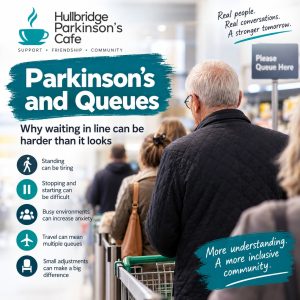
Standing Still Isn’t Necessarily Resting
We tend to think of standing still as easier than walking.
But standing requires continuous postural control.
Your body is constantly making tiny adjustments to keep you balanced, even though you may feel as though you’re doing nothing.
Parkinson’s can affect balance, posture and automatic movement.
For some people, standing in one place for several minutes can therefore become tiring or uncomfortable.
Legs may feel stiff.
Posture may become more difficult to maintain.
Some people may feel increasingly unstable.
And unlike walking, where movement itself provides rhythm and momentum, a queue repeatedly asks the body to stop completely.
Then Suddenly You’re Expected to Move
This is one of the peculiar things about queues.
You might stand still for thirty seconds.
Then the person in front moves half a metre.
Everybody behind you expects you to move too.
Immediately.
For somebody experiencing bradykinesia or difficulty initiating movement, that sudden transition from standing still to taking the first step may not happen instantly.
The intention is there.
The person knows perfectly well that the queue has moved.
But the body may take longer to respond.
That small delay can feel enormous when somebody is standing directly behind you.
Freezing Can Make Queues Particularly Difficult
Some people with Parkinson’s experience freezing of gait.
This can create the sensation that the feet are temporarily stuck to the floor even though the person intends to move.
Freezing can occur in different situations and varies considerably from person to person.
Starting to walk can be one trigger for some people.
Busy or confined environments can also make movement more difficult.
A queue may contain several of those challenges at once:
- Standing still and then restarting.
- People standing close together.
- Narrow barriers or checkout lanes.
- Pressure to keep moving.
- Distractions and noise.
- Turning or changing direction.
What looks like somebody simply being slow may actually involve considerable concentration and effort.
The Person Behind You Can Add Pressure Without Saying a Word
Most people have experienced that feeling in a queue.
The person behind you moves closer.
The queue moves.
You haven’t moved yet.
You become very aware that everybody is waiting.
For someone with Parkinson’s, that pressure can make an already difficult movement even harder.
Being rushed can increase anxiety.
And anxiety, stress or divided attention can make certain Parkinson’s symptoms more noticeable for some people.
Suddenly, a simple first step becomes something you’re thinking about while simultaneously worrying about everybody around you.
That is quite different from simply walking across an empty room at home.
Queues Often Remove the Things That Help
People naturally develop strategies for managing their Parkinson’s.
They may walk at their own pace.
Pause before starting.
Use a mobility aid.
Take wider turns.
Use visual or rhythmic cues recommended by a healthcare professional.
Choose somewhere to sit when tired.
A queue doesn’t always allow that freedom.
You move when the queue moves.
You stop where the queue stops.
The available space is determined by barriers, counters and other people.
There may be nowhere to sit.
And if somebody needs a little extra time, the environment often provides the exact opposite: pressure to hurry.
Fatigue Can Build While You’re Waiting
Imagine going to a supermarket.
You have already walked around the shop.
Reached for items.
Pushed a trolley or carried a basket.
Made decisions.
Possibly dealt with a busy, noisy environment.
By the time you reach the checkout, you may already be tired.
Then there is a queue.
For someone affected by Parkinson’s-related fatigue, those extra minutes of standing may be considerably more demanding than they appear.
The queue is not necessarily the hardest part of the shopping trip.
It may simply be the point at which all the effort that came before becomes noticeable.
Airports Can Magnify the Problem
Airports are a particularly good example.
Check-in.
Security.
Passport control.
Boarding.
Sometimes baggage collection.
A single journey can involve several queues, often combined with long distances, luggage, time pressure and unfamiliar surroundings.
For somebody living with Parkinson’s, that can be exhausting before the flight has even started.
Many airports and airlines provide assistance services for passengers who have reduced mobility or other accessibility needs.
People should not feel that they have to reach a particular level of disability before asking what support is available.
If queues, walking distances or prolonged standing are difficult, it may be worth arranging assistance in advance.
Sitting Down Isn’t “Jumping the Queue”
Sometimes accessibility requires us to rethink what a queue should look like.
Does everybody genuinely need to stand?
Could someone wait nearby in a chair while maintaining their place?
Could a companion remain in the queue?
Could staff call somebody forward when it’s their turn?
Could priority or accessible service arrangements be used where available?
These aren’t attempts to gain an unfair advantage.
They are ways of achieving the same outcome without requiring somebody to perform a physical task that may be unnecessarily difficult.
Equality does not always mean making everybody stand in exactly the same line in exactly the same way.
If You’re With Someone Who Has Parkinson’s
A little awareness can make queues easier.
Don’t automatically pull or push somebody forward when the queue moves.
Sudden physical assistance can sometimes affect balance and may be more hindrance than help.
Instead, give them the time and space to initiate movement.
If they want assistance, ask what would help.
If the queue is long, consider whether there is somewhere they could sit.
And if staff are available, there is nothing wrong with politely asking whether an accessible alternative exists.
Most importantly, don’t make somebody feel guilty because other people are waiting for a few extra seconds.
For Businesses, This Is an Accessibility Issue
Accessibility isn’t only about ramps and door widths.
It is also about how services are organised.
A business may technically be accessible while still requiring customers to stand for twenty minutes in order to receive service.
Simple adjustments can help enormously.
- Providing seating near long queues.
- Allowing customers to retain their place while sitting.
- Offering ticket or number systems instead of physical lines.
- Providing accessible checkout or service points.
- Training staff to recognise that not every disability is immediately visible.
- Giving people time rather than repeatedly telling them to hurry.
None of these measures is particularly complicated.
But they can make the difference between somebody completing an everyday task independently and deciding that the experience is simply too difficult.
Not Every Difficulty Is Visible
This is perhaps the larger lesson.
Somebody standing in front of you in a queue may look perfectly capable of moving faster.
They may not use a wheelchair.
They may not have a walking stick.
You may see nothing that immediately suggests a disability.
But Parkinson’s does not always announce itself visibly.
That person may be concentrating intensely on initiating their next step.
They may be balancing carefully.
They may be experiencing rigidity.
They may be exhausted.
They may be waiting for their medication to take effect.
Or they may simply need five more seconds than you do.
Five seconds is not a long time.
It only feels that way when we’ve decided everybody should move at exactly the same speed.
The Queue Isn’t the Problem — The Assumption Is
Queues are part of everyday life.
We cannot remove all of them.
And many people with Parkinson’s will use them without significant difficulty.
Parkinson’s affects everybody differently.
But for those who do struggle, the solution may begin with something extremely simple.
Recognise that standing still, starting again and being rushed are not effortless for everybody.
Give people space.
Give them time.
Provide alternatives where possible.
And perhaps the next time somebody takes a little longer to move forward in a queue, resist the temptation to sigh.
They may already be working considerably harder than you realise.
Hullbridge Parkinson’s Cafe is a friendly, informal community for people living with Parkinson’s, their partners, families and carers.
We meet at Hullbridge Free Church, 47–48 Lower Road, Hullbridge, Essex SS5 6DF, on the first and third Tuesday of every month from 11:00am–1:00pm.
No booking is required and new faces are always welcome.
If freezing, balance problems, fatigue or other movement changes are affecting everyday activities, speak with your Parkinson’s specialist, physiotherapist, occupational therapist or another appropriate healthcare professional for individual advice.