
Parkinson’s in Hospital: Why Medication Timing Matters So Much
Imagine being admitted to hospital for something completely unrelated to Parkinson’s.
Perhaps you’ve had a fall.
Perhaps you need an operation.
Or perhaps you’ve developed an infection that requires treatment.
You’re given a bed, the nursing staff begin their assessments, and someone asks which medications you normally take.
You explain that you have Parkinson’s and provide your medication details.
Everything seems straightforward.
Then the time arrives for your next Parkinson’s dose.
Nothing happens.
You ask about it.
You’re told the medication round is running late, or that your medicine hasn’t yet arrived from the hospital pharmacy.
Perhaps somebody explains that the ward normally gives medications at set times.
For many medicines, a modest variation in timing may be manageable.
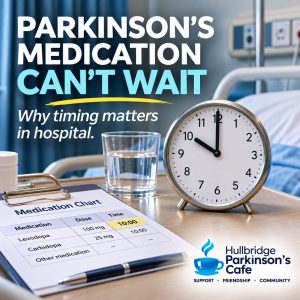
But for some Parkinson’s medications, particularly levodopa, the exact timing can make an enormous difference.
And what appears to be a routine hospital delay can become a significant problem for the patient.
 Why Parkinson’s Medication Is Different
Parkinson’s affects the brain’s ability to produce and use dopamine, a chemical messenger involved in controlling movement.
One of the most widely prescribed treatments is levodopa, which the brain converts into dopamine.
Levodopa can improve symptoms such as slowness, stiffness and difficulties with movement.
But its effects do not necessarily last throughout the day.
Many people take several doses at carefully planned times to maintain symptom control.
For some, the difference between taking medication at the prescribed time and taking it significantly later can be substantial.
They may experience increased stiffness.
Walking may become more difficult.
Getting out of bed or a chair may require more assistance.
Speech may become quieter.
Swallowing can become more difficult.
And some people may experience freezing episodes, where movement temporarily becomes difficult to initiate.
These changes are not simply an inconvenience.
They can affect someone’s safety and ability to participate in their own care.
The Problem With Standard Hospital Medication Rounds
Hospitals care for large numbers of patients, often with complex medication requirements.
To manage this safely, wards use established systems for prescribing, dispensing and administering medicines.
But a standard medication schedule may not match the times someone with Parkinson’s follows at home.
Imagine a person who normally takes levodopa at 7am, 10am, 1pm, 4pm and 7pm.
These times may have been carefully adjusted with their Parkinson’s specialist to provide the best possible symptom control.
If a hospital substitutes routine administration times, such as 8am, midday and 6pm, that is not simply a minor administrative change.
It may significantly alter the person’s treatment.
For this reason, Parkinson’s UK and NHS patient-safety guidance emphasise the importance of recognising time-critical Parkinson’s medication.
For medicines classified as time-critical, administration should follow the individual’s prescribed schedule, with the aim of giving doses within 30 minutes of the required time.
That is not permission to delay every dose by half an hour. The objective remains to give the medication when prescribed.
What Can Happen When Doses Are Missed?
A missed or significantly delayed dose may lead to a deterioration in Parkinson’s symptoms.
Someone who was walking reasonably well earlier in the day may suddenly need assistance.
They may become much stiffer.
They may struggle with tasks that were manageable only a few hours before.
In some cases, worsening symptoms may increase the risk of falls, difficulties with swallowing or complications associated with reduced mobility.
More seriously, abrupt withdrawal or major interruption of dopaminergic medication can occasionally cause a rare but potentially life-threatening condition known as parkinsonism-hyperpyrexia syndrome.
This can involve severe rigidity, fever, changes in consciousness and autonomic instability.
It requires urgent medical attention.
Most medication delays do not lead to this complication, but the possibility reinforces why Parkinson’s treatment should never be stopped abruptly without appropriate specialist management.
It’s Not Just About Remembering the Medication
There is another important distinction.
Giving the right medicine is essential.
But so is giving the right dose, at the right time, in the correct formulation.
Parkinson’s medicines are available in different strengths and preparations.
Some are immediate-release.
Others are modified-release.
Some are taken several times a day.
Others may be delivered through patches, pumps or other specialist systems.
These preparations are not necessarily interchangeable.
Substituting one formulation for another without appropriate clinical assessment can alter how the treatment works.
Hospitals therefore need an accurate record of the person’s current medication, including the precise product, strength, dose and administration times.
This is particularly important when a patient is admitted unexpectedly and their usual Parkinson’s team may not be immediately available.
What If Someone Cannot Swallow Their Medication?
Hospital admissions sometimes create difficulties that do not exist at home.
A patient may be temporarily unable to swallow tablets.
They may be instructed not to eat or drink before surgery.
They may have nausea, vomiting or a swallowing problem.
In these circumstances, simply omitting Parkinson’s medication can be dangerous.
Instead, the medical team should arrange an appropriate treatment plan, seeking advice from a Parkinson’s specialist or suitably experienced pharmacist where necessary.
Depending on the individual’s treatment and clinical circumstances, alternatives may include different formulations or routes of administration.
These decisions require professional assessment.
Not every Parkinson’s medicine can be crushed, dissolved or substituted safely.
Patients and families should never crush tablets or change how Parkinson’s medication is administered without guidance from the treating healthcare team.
Operations and Anaesthesia Need Planning Too
For someone with Parkinson’s who needs surgery, medication planning should begin before the procedure whenever possible.
There may be restrictions on eating and drinking.
There may be delays in the operating schedule.
Recovery from anaesthesia may temporarily affect swallowing or the ability to take oral medicines.
All of these can interfere with the usual medication routine.
For planned surgery, the patient should make sure the pre-operative assessment team knows about their Parkinson’s and the exact medication schedule.
The anaesthetist and surgical team can then consider how treatment will be maintained throughout the admission.
This may involve coordinating medication around the procedure or arranging suitable alternatives if oral treatment is temporarily impossible.
For emergency surgery, the same principles apply, although there may be less time to prepare.
Some Hospital Medicines Can Make Parkinson’s Worse
Another important consideration is that certain medicines commonly used to treat nausea, agitation or other symptoms can worsen Parkinson’s.
Some medications block dopamine receptors, potentially aggravating movement difficulties.
Examples that are generally avoided in Parkinson’s include metoclopramide, prochlorperazine and haloperidol, unless a specialist determines that a particular use is appropriate.
That doesn’t mean people with Parkinson’s cannot receive treatment for nausea or other hospital-related problems.
It means the healthcare team should select medicines with appropriate consideration of Parkinson’s and the patient’s wider medical circumstances.
Families should make sure staff know about the diagnosis, but prescribing decisions must remain with qualified healthcare professionals.
Preparing for a Planned Hospital Admission
If you know that you or someone you support will be going into hospital, a little preparation can make a significant difference.
1. Keep an Accurate Medication List
Record every prescribed medicine, its strength, the dose taken and the exact time it should be administered.
Include any relevant instructions about meals and the formulation used.
Make sure the list reflects the current prescription rather than an older treatment plan.
2. Explain That Medication Is Time-Critical
Do not assume every member of staff will immediately recognise the importance of individual Parkinson’s medication timings.
Explain the schedule clearly during admission and ask how the ward will ensure the prescribed times are followed.
3. Ask About Self-Administration
Some hospitals have policies allowing suitable patients to manage their own medicines while admitted.
Whether this is appropriate depends on the patient’s abilities, clinical condition and the hospital’s assessment and procedures.
It should only happen with the agreement of the healthcare team.
4. Bring Relevant Information
Where permitted and requested by the hospital, bringing medicines in their original labelled packaging may help staff confirm the treatment regimen.
However, patients should not take their own medication independently while in hospital unless this has been agreed and documented by the clinical team.
5. Involve the Parkinson’s Team
If possible, inform the Parkinson’s specialist nurse or consultant about a planned admission.
They may be able to advise on medication arrangements, particularly where surgery or swallowing difficulties are expected.
What Families Can Do During an Unexpected Admission
Emergency admissions are often stressful.
There may be little time to prepare.
But family members and carers can still help by providing accurate information.
If the person with Parkinson’s agrees, or where information sharing is otherwise appropriate, relatives can explain the normal medication schedule and identify important aspects of the person’s daily routine.
They may also be able to describe how the person’s movement, speech or behaviour typically changes when medication wears off.
This can be useful because hospital staff may only see the patient during a period when their symptoms are poorly controlled.
Without knowing the person’s usual abilities, it may be difficult to distinguish their baseline condition from a temporary deterioration.
Families should also feel able to raise concerns if prescribed Parkinson’s medication is repeatedly delayed or omitted.
That should be done calmly and clearly, using the ward’s established escalation procedures.
What Should You Do If a Dose Is Late?
If a Parkinson’s medication dose is overdue during a hospital admission, notify the nurse responsible for the patient’s care promptly.
Explain the prescribed administration time and why the medicine is time-critical.
If the issue cannot be resolved, ask for the nurse in charge or an appropriate member of the medical or pharmacy team to review the situation.
Repeated difficulties may require input from a Parkinson’s specialist team.
Do not independently give additional doses or attempt to compensate for a missed dose without medical guidance.
The appropriate response depends on the specific medication, the length of the delay and the patient’s clinical condition.
When Symptoms Suddenly Become Worse in Hospital
Someone with Parkinson’s may experience a noticeable deterioration during a hospital stay.
Medication delays are one possible explanation.
But they are not the only one.
Infections, dehydration, constipation, pain, sleep disruption, delirium and other medical problems can also affect symptoms.
A sudden change should therefore be assessed rather than automatically attributed to Parkinson’s itself.
This is especially important when the person develops new confusion, fever, severe stiffness, difficulty swallowing or a marked reduction in mobility.
These changes should be brought to the attention of the treating team promptly.
Discharge Planning Matters as Well
Medication safety doesn’t end when someone leaves hospital.
During an admission, prescriptions may be adjusted.
New medicines may be introduced.
Existing treatments may be temporarily changed.
Before discharge, the patient and their family or carer should understand the current medication plan.
That includes:
- Which medicines should be taken at home.
- The prescribed doses and exact timings.
- Whether any medicines have been stopped or changed.
- Whether temporary changes need reviewing.
- Who to contact if symptoms become difficult to manage.
- What follow-up appointments or specialist reviews are required.
Where appropriate, medication changes should be communicated to the GP and Parkinson’s specialist team.
Patients should also have access to the medicines they need when they return home, in accordance with the discharge plan.
Why This Is a Patient Safety Issue
It’s easy to view medication timing as an administrative detail.
A dose is scheduled.
A nurse administers it.
The time is recorded.
But Parkinson’s demonstrates why medication systems sometimes need to accommodate individual requirements.
For someone whose movement and functioning depend on carefully timed treatment, a significant delay can affect much more than comfort.
It can influence mobility, swallowing, communication and participation in rehabilitation.
It may also complicate the treatment of the condition that brought them into hospital in the first place.
Recognising time-critical medication is therefore part of safe, person-centred care.
A Hospital Admission Shouldn’t Mean Losing Control of Parkinson’s
Hospitals are busy and complex environments.
Healthcare professionals manage many competing demands, often under considerable pressure.
Medication errors and delays are not unique to Parkinson’s.
But the consequences of delayed dopaminergic treatment can be particularly important.
That makes awareness essential.
Patients should be encouraged to explain their medication needs.
Families should know how to provide accurate information.
And healthcare organisations should have reliable procedures for identifying and administering time-critical medicines.
Not every delay can be prevented.
Not every deterioration is caused by medication.
But avoidable disruption to Parkinson’s treatment should not be accepted as an inevitable part of being admitted to hospital.
When someone with Parkinson’s enters hospital, their treatment needs to enter with them.
Because the condition doesn’t disappear simply because the reason for admission is something else.
Further Information
For guidance on Parkinson’s medication and hospital care, visit:
- Parkinson’s UK — information about Parkinson’s medication, hospital care and the Get It On Time campaign.
- NHS — Parkinson’s Disease — general information about symptoms, treatment and support.
Join Us at Hullbridge Parkinson’s Cafe
At Hullbridge Parkinson’s Cafe, we believe sharing practical information can help people living with Parkinson’s and their families feel better prepared for everyday challenges.
Our friendly, informal meetings welcome people with Parkinson’s, their partners, families and carers.
We meet at Hullbridge Free Church, 47–48 Lower Road, Hullbridge, Essex SS5 6DF, on the first and third Tuesday of every month, from 11:00am to 1:00pm.
No booking is required, and new faces are always welcome.
Find out more at https://parkinsonscafe.co.uk/.
This article is intended for general information and does not replace advice from qualified healthcare professionals. Parkinson’s medication should only be changed or administered according to an appropriate prescribed treatment plan.