
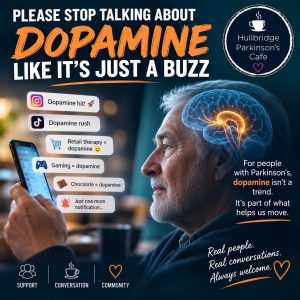
Please Stop Talking About Dopamine Like It’s Just a Buzz
For people living with Parkinson’s, dopamine isn’t a wellness trend, a social-media hack or shorthand for having a good time. It is part of the biology behind something as fundamental as being able to move.
There are certain words that suddenly seem to appear everywhere.
At the moment, one of them is dopamine.
Scroll through social media and you’ll encounter phrases like:
- “Get your dopamine hit.”
- “This gives me a dopamine rush.”
- “I’m doing a dopamine detox.”
- “Stop chasing cheap dopamine.”
- “Here’s how to reset your dopamine.”
The word has become shorthand for almost anything pleasurable, exciting or habit-forming.
A notification.
Chocolate.
Shopping.
Gaming.
Scrolling through social media.
Winning something.
Buying something.
Even somebody enjoying their morning coffee can apparently be described as “chasing dopamine”.
For many people, it’s harmless internet language.
But if Parkinson’s is part of your life, hearing dopamine discussed this way can sound very different.
Because dopamine isn’t simply the chemical responsible for making somebody feel good.
And for somebody with Parkinson’s, its loss has consequences considerably more serious than whether they can resist checking their phone.
Dopamine Isn’t Just the “Pleasure Chemical”
Popular explanations of neuroscience have a habit of turning complicated biology into catchy labels.
Serotonin becomes the “happiness chemical”.
Cortisol becomes the “stress hormone”.
Dopamine becomes the “pleasure chemical”.
The problem is that biology rarely fits neatly into a social-media caption.
Dopamine is a neurotransmitter — a chemical messenger used by the nervous system — with several important functions.
It is involved in motivation, learning and reward processing.
But it is also critically involved in movement.
That last part matters enormously when we’re talking about Parkinson’s.
What Dopamine Means in Parkinson’s
Deep within the brain is an area called the substantia nigra.
It contains neurons that produce dopamine and communicate with brain circuits involved in controlling movement.
In Parkinson’s, these dopamine-producing neurons progressively deteriorate.
As dopamine signalling in the relevant movement circuits becomes impaired, the brain finds it increasingly difficult to regulate movement normally.
That contributes to some of the characteristic movement problems associated with Parkinson’s.
- Movements can become slower.
- Muscles can become rigid.
- Starting a movement can become difficult.
- Automatic movements can change.
- Walking can become more complicated.
This isn’t somebody failing to generate enough excitement.
It isn’t something that can be corrected by avoiding Instagram for the weekend.
It is neurodegenerative disease.
This Isn’t the Same as an Adrenaline Rush
This may be where some of the everyday language becomes particularly misleading.
We’re accustomed to talking about an adrenaline rush.
And that description makes intuitive sense.
Something frightening or exciting happens.
Your body’s fight-or-flight response activates.
Your heart races.
You feel alert.
The immediate event passes and that acute physiological response subsides.
So when people started talking about a “dopamine rush” or “dopamine hit”, dopamine began acquiring a similar cultural meaning.
A quick blast of something that feels good.
But dopamine’s biology is considerably more complicated.
There can indeed be rapid changes in dopamine signalling associated with learning, motivation and reward prediction.
There are also more sustained aspects of dopamine signalling, and different dopamine pathways perform different functions.
So the problem isn’t that dopamine has nothing whatsoever to do with rewarding experiences.
It does.
The problem is pretending that’s all dopamine is.
 You Cannot “Detox” From Dopamine
The phrase that perhaps demonstrates the confusion most clearly is:
“Dopamine detox.”
You cannot detox from dopamine in the literal sense.
Nor would you want to.
Avoiding pleasurable activities does not simply empty the brain of dopamine and then allow some imaginary dopamine reservoir to refill.
Reducing compulsive phone use may be beneficial.
Taking a break from social media may be beneficial.
Going for a walk instead of scrolling for three hours may be beneficial.
None of that requires pretending we’re periodically draining and refilling a dopamine tank.
Calling these activities a “dopamine detox” might make a good headline.
It doesn’t make it good neuroscience.
Imagine Hearing This When You Have Parkinson’s
This is where scientific inaccuracy meets lived experience.
Imagine struggling to stand from a chair.
Imagine your feet refusing to initiate the first step even though you know exactly where you want to go.
Imagine movements that happened automatically throughout your life suddenly requiring concentration.
Imagine relying on carefully timed medication to help you move more effectively.
Then open your phone and discover somebody explaining that they’re going to “reset their dopamine” because they’ve been watching too much Netflix.
It’s understandable if that terminology occasionally grates.
For people living with Parkinson’s, dopamine isn’t an abstract wellness concept.
Its loss is connected to real changes in everyday function.
And Treatment Shows Just How Important It Is
One of the principal treatments for Parkinson’s is levodopa.
Dopamine itself cannot simply be taken as a tablet and transported effectively into the brain because it doesn’t readily cross the blood-brain barrier.
Levodopa can cross that barrier and is converted into dopamine in the brain.
That can improve Parkinson’s symptoms for many people.
But treatment isn’t equivalent to replacing a battery and returning everything permanently to normal.
Medication response can change over time.
Some people experience fluctuations between periods when medication is working effectively and periods when symptoms become more noticeable.
Treatment therefore becomes part of everyday life — sometimes involving careful timing and adjustment with specialist healthcare teams.
That is a very different relationship with dopamine from chasing another “hit” from a smartphone notification.
Words Change Meaning — But Context Matters
None of this means people should be reprimanded every time they casually use the word dopamine.
Language evolves.
“Dopamine hit” has entered everyday vocabulary.
Most people using it aren’t trying to belittle Parkinson’s.
And people with Parkinson’s don’t all feel the same way about the terminology.
But perhaps we could become a little more thoughtful about the language.
Because there is an important difference between saying:
“That made me feel good.”
and presenting an enormously complex neurotransmitter as though its sole purpose is delivering tiny parcels of happiness.
Dopamine isn’t simply pleasure.
It isn’t simply motivation.
It isn’t simply movement.
It participates in several complex neural systems, and scientists are still studying precisely how those systems interact.
That complexity deserves more respect than the internet usually gives it.
For Parkinson’s, This Isn’t a Trend
Eventually another wellness buzzword will probably replace dopamine.
Social media will move on.
There will be another “hack”.
Another detox.
Another chemical somebody promises we can optimise in five easy steps.
Parkinson’s will still be here.
And people living with it will still be dealing with the consequences of losing neurons responsible for dopamine signalling in the brain.
So perhaps the next time somebody tells us they’re “chasing dopamine”, it’s worth remembering:
For millions of people living with Parkinson’s around the world, dopamine isn’t shorthand for excitement.
It isn’t an internet trend.
It isn’t something they can reset over the weekend.
It is part of a neurological system whose deterioration can affect something as fundamental as taking the next step.
And that puts the word in a very different perspective.
Hullbridge Parkinson’s Cafe is a friendly, informal community for people living with Parkinson’s, their partners, families and carers.
We meet at Hullbridge Free Church, 47–48 Lower Road, Hullbridge, Essex SS5 6DF, on the first and third Tuesday of every month from 11:00am–1:00pm.
New faces are always welcome.