
When Your Face Doesn’t Show How You Feel: Parkinson’s and Facial Expression
We read faces constantly.
A smile tells us somebody is pleased to see us.
A raised eyebrow suggests surprise.
A change around the eyes can tell us somebody is amused before they have said a word.
Most of us interpret these signals without even realising we’re doing it.
But Parkinson’s can sometimes change the way emotion appears on somebody’s face.
The person may be interested, happy, excited or amused — yet their expression may not communicate those feelings as clearly as it once did.
And that can lead to one of the more easily misunderstood aspects of living with Parkinson’s.
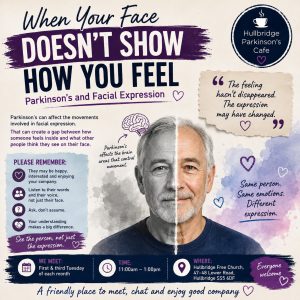 The Feeling Hasn’t Disappeared
Parkinson’s can affect the automatic movements involved in facial expression. Reduced facial expression is sometimes called hypomimia or facial masking.
It doesn’t mean the person has stopped experiencing emotion.
Someone can be thoroughly enjoying a conversation without displaying the facial reactions other people expect.
They can find something funny without producing an immediate broad smile.
They can be interested in what you’re saying while appearing unusually serious.
The important distinction is simple:
A change in expression is not necessarily a change in feeling.
Imagine Being Told to Cheer Up When You’re Already Happy
Think about how strange that could feel.
You’re sitting with friends enjoying yourself and somebody asks:
“What’s wrong?”
You say nothing is wrong.
They look unconvinced.
“Are you sure?”
You reassure them.
Then comes:
“You don’t look very happy.”
From the other person’s perspective, they may simply be showing concern.
But if it happens repeatedly, it can become frustrating.
You’re being asked to explain an emotion you aren’t actually experiencing because somebody else has interpreted your facial expression for you.
It Can Affect Conversations
Facial expressions are an important part of communication.
When somebody tells a story, they naturally look at the listener for feedback.
A smile.
A nod.
A look of surprise.
A reaction that effectively says:
“I’m listening. Keep going.”
If those signals become less obvious, the speaker may mistakenly think the person with Parkinson’s isn’t interested.
They may shorten the conversation.
They may direct their attention towards somebody else.
Or they may start speaking about the person rather than to them.
None of this may be deliberate.
It can simply result from humans being extremely accustomed to using faces as part of conversation.
“You Look Angry.”
This can be particularly difficult in relationships.
A partner may interpret a neutral expression as irritation.
A friend might think somebody is bored.
A shop assistant may assume they are unfriendly.
A stranger might decide they don’t want to engage.
Even family members who understand Parkinson’s can occasionally forget that the face they are seeing doesn’t necessarily tell the whole story.
Over time, these small misunderstandings can accumulate.
That’s why awareness among the people around somebody with Parkinson’s can make such a difference.
Listen to the Person, Not Just Their Face
If you know somebody whose facial expression has changed because of Parkinson’s, one of the most useful things you can do is stop trying to interpret every emotion from appearance alone.
Listen to what they say.
Listen to their tone.
Give them time to respond.
Ask rather than assume.
If they tell you they’re enjoying themselves, believe them.
If they say they’re fine, don’t automatically decide their face is telling you otherwise.
Communication is much bigger than a facial expression.
Don’t Mistake Less Expression for Less Personality
This may be the most important misunderstanding of all.
The person you know hasn’t suddenly become less interesting because their face moves differently.
Their sense of humour hasn’t necessarily disappeared.
Their opinions haven’t vanished.
Their affection for the people around them hasn’t been erased.
They haven’t stopped noticing the ridiculous things happening around them.
And they certainly haven’t stopped being themselves.
Sometimes the outward signal has simply become quieter.
There May Be More Going On Than You Can See
This connects with something we return to regularly at Hullbridge Parkinson’s Cafe:
Parkinson’s isn’t always obvious from the outside.
Sometimes people assume somebody is fine because they “look well”.
In this situation, almost the opposite can happen.
People assume somebody is unhappy, disengaged or unfriendly because of how they look.
Both mistakes come from the same place — trying to understand somebody’s experience entirely from their appearance.
People are more complicated than that.
What Can Help?
Everyone experiences Parkinson’s differently, and changes in facial expression vary considerably from person to person.
If changes are causing difficulties with communication or everyday life, it is worth discussing them with the appropriate healthcare professional. Parkinson’s specialists and speech and language therapists may be able to offer individual advice and strategies.
For friends and relatives, however, one of the most useful adjustments doesn’t require any specialist equipment.
It requires understanding.
Don’t demand a smile.
Don’t repeatedly ask somebody what’s wrong because their face looks serious.
Don’t assume silence or reduced expression means disinterest.
And don’t exclude somebody from a conversation because you’re getting less visible feedback than you expect.
Keep talking to the person.
See the Person Behind the Expression
A face tells us a great deal.
But it doesn’t tell us everything.
For somebody living with Parkinson’s, there may occasionally be a gap between the emotion they are experiencing and the expression other people see.
Understanding that gap can prevent unnecessary misunderstandings.
The person who appears serious may be enjoying every minute.
The person who doesn’t immediately smile may be delighted to see you.
The person whose face seems quieter may still have exactly the same humour, warmth, opinions and personality you have always known.
Parkinson’s may change the expression.
It doesn’t define the person behind it.
Join Us at Hullbridge Parkinson’s Cafe
Hullbridge Parkinson’s Cafe is a friendly and informal place for people living with Parkinson’s, together with partners, family members and carers, to meet others, enjoy some company and share experiences if they wish.
Where: Hullbridge Free Church, 47–48 Lower Road, Hullbridge, Essex SS5 6DF
When: First and third Tuesday of each month
Time: 11:00am–1:00pm
There’s no need to book. New faces are always welcome. 💙