
Why Parkinson’s Can Make Everyday Choices Feel More Overwhelming
How Parkinson’s Can Make Everyday Choices Feel More Overwhelming
Every day, we make hundreds of decisions without really thinking about them.
What to wear. What to eat. Which route to take. What to buy at the supermarket.
For most people these choices happen almost automatically.
For some people living with Parkinson’s, however, even simple decisions can begin to feel surprisingly demanding.
This isn’t because someone has become indecisive. It is because Parkinson’s can affect the brain processes involved in planning, organising and evaluating information.
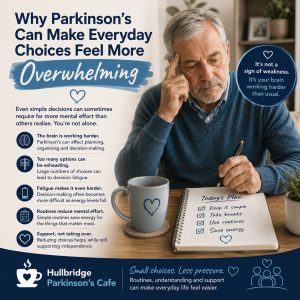 The brain is working harder
Parkinson’s affects the areas of the brain responsible for movement, but it can also influence executive function.
Executive function helps us plan, organise, prioritise and make decisions.
When these processes require more effort, everyday choices may feel mentally tiring.
Too many options can become exhausting
Imagine opening a wardrobe full of clothes and trying to decide what to wear.
Or standing in a supermarket faced with dozens of similar products.
When the brain is already working harder than usual, large numbers of choices can become overwhelming.
This is sometimes known as “decision fatigue.”
Fatigue makes it even harder
Many people living with Parkinson’s already experience physical and mental fatigue.
As energy levels fall throughout the day, decision-making often becomes more difficult.
Something that felt manageable in the morning may feel much harder later in the afternoon.
Small routines can reduce mental effort
Many people naturally develop routines that reduce the number of decisions they need to make.
This isn’t about giving up independence.
It’s about conserving mental energy for the things that matter most.
Simple examples include:
- Planning meals in advance.
- Laying clothes out the night before.
- Keeping frequently used items in the same place.
- Following familiar daily routines.
- Using shopping lists.
Family members can help without taking over
Loved ones sometimes assume they need to make every decision on behalf of someone with Parkinson’s.
Often, a better approach is simply reducing the number of choices.
For example, instead of asking “What would you like for dinner?”, it may be easier to ask, “Would you prefer chicken or fish tonight?”
This still allows the person to make their own decision while reducing unnecessary mental effort.
It’s not a sign of weakness
Needing more time to make decisions is not a sign of weakness or lack of intelligence.
It simply reflects the extra work the brain may be doing.
Allowing extra time and reducing pressure can make everyday life much less stressful.
The hidden side of Parkinson’s
Feeling overwhelmed by everyday choices is another reminder that Parkinson’s affects much more than movement alone.
You may also find these related articles helpful:
- Why Parkinson’s Can Make Everyday Decisions More Difficult
- Why Parkinson’s Can Affect Reading and Concentration
- Why Parkinson’s Can Make It Harder to Start Tasks
Making fewer decisions is not about doing less. Sometimes it is simply about using your energy wisely. By reducing unnecessary choices and creating supportive routines, people living with Parkinson’s can often make everyday life feel calmer, more manageable and less overwhelming.
⸻
Hullbridge Parkinson’s Cafe is a welcoming community where people living with Parkinson’s, carers, families and friends can share experiences, discover practical advice and support one another through every stage of the journey.